


There’s a dirty little secret that everyone knows about in the publishing industry: most news stories are ripped from other sources.
Not all of it, obviously. That would be daft. There’s still lots of original reporting, an army of fantastic columnists, plenty of impactful live coverage and loads of really distinctive local news outlets. But a huge volume of newsroom output still boils down to this: taking a story someone else has written, reworking it and then publishing it quickly in the hope that search or social or will do the rest.
That model was shaky before. Now it is actively dangerous.
Because once your journalism becomes interchangeable, you are no longer competing on value. You are competing on speed, volume, distribution luck and institutional muscle. And in a world of AI summaries, collapsing referral traffic, platform dependency and audience fatigue, that is not the place you want to be.
But if everyone is doing this and knows it’s not sustainable, why is it so hard to change?
The answer lies in communications, technology and culture.
First, the communications problem
A lot of newsroom change fails before it even starts because people are not actually talking about the same thing.
I’ll put my hand up. I’ve definitely been in a room talking about ‘content’ and ‘audience needs’ where everyone has nodded (and even fist-pumped). But when the emails start to come in, you realise you were speaking the same language but from entirely different perspectives.
It can be the same when leadership says the organisation needs to be more ‘distinctive’. Editors hear that as “do more exclusives.” Audience teams hear “find more search opportunities.” Reporters hear “do more with fewer resources.” Product teams hear nothing because nobody invited them to the meeting in the first place.
That is how you end up with a strategic ambition that sounds bold on a slide deck and then quietly turns into more of the same output with slightly different language wrapped around it.
“Be less commodified” is not a strategy. It is a diagnosis.
If you want change, you need a much clearer internal language around value. What exactly should this newsroom be uniquely good at? What should readers be unable to get elsewhere? Which stories are we covering because they matter to our audience, and which are we covering because everyone else is? What formats genuinely help people? Where do we have authority, proximity, trust or expertise?
These sound like basic questions. In practice, many organisations do not answer them with enough precision. Or they answer them once, in a strategy document that is soon forgotten on your intranet or in an AI-generated image like this:
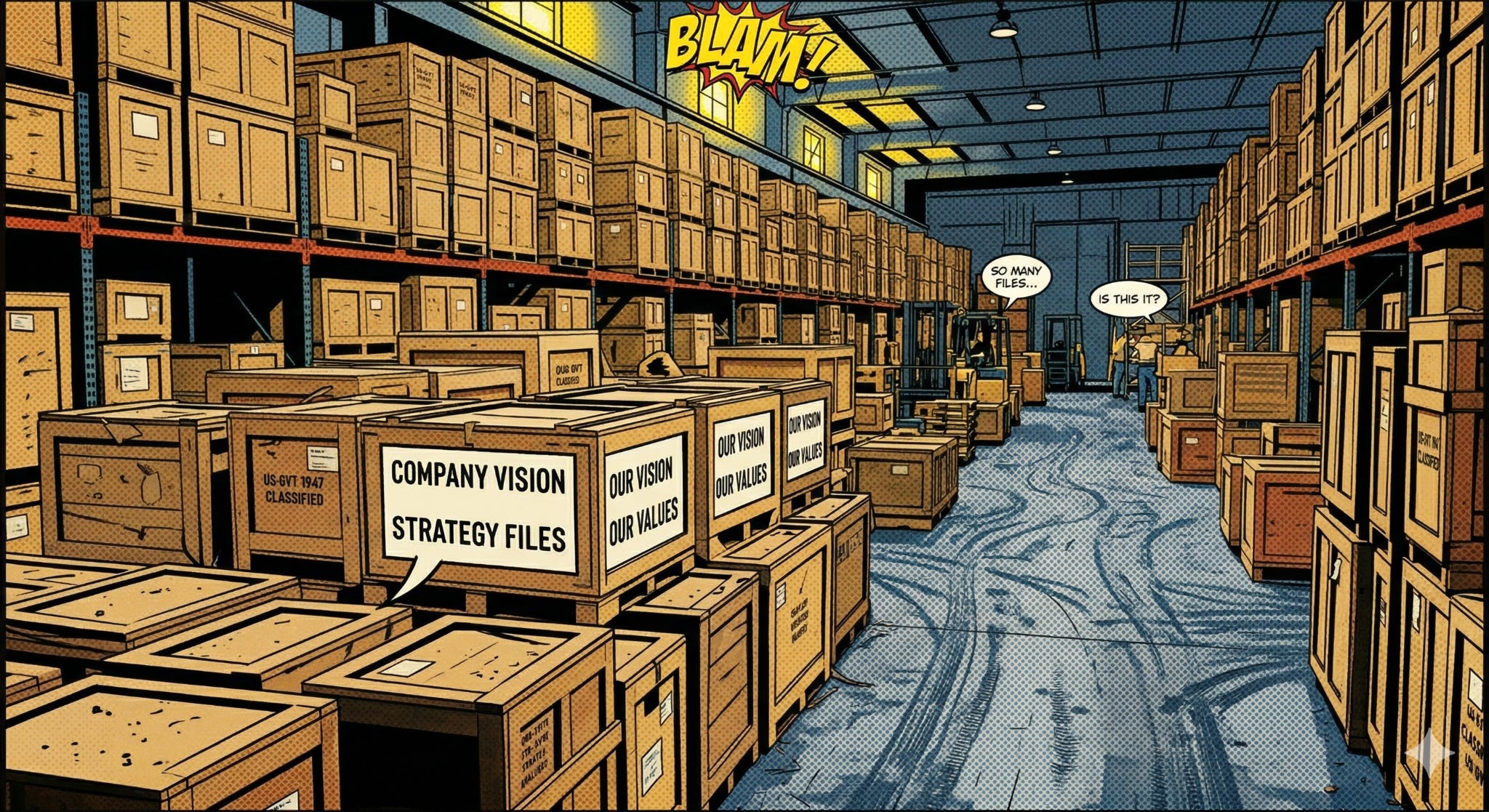
That is the communications trap: people think they agree because they are all using the same buzzwords. Distinctive. Audience-first. Digital. Value. Utility. Trust. But unless those ideas are translated into clear editorial choices, teams default back to familiar behaviour.
And familiar behaviour in newsrooms usually means doing the same ‘ol thing.
(Side Note: The ‘Good Strategy Bad Strategy’ book by Richard Rumelt has some great pointers when it comes to actionable strategies.)
Then there’s the technology problem
Newsroom publishing systems are not neutral. They shape behaviour.
If your CMS is built for rapid article production, homepage turnover and incremental rewrites, you will produce rapid article production, homepage turnover and incremental rewrites. If your analytics setup rewards short-term traffic spikes above all else, people will chase short-term traffic spikes above all else. If your editorial tooling makes it easy to knock out ten near-identical commodified stories and hard to build a live page, a guide, a tracker, a database or a genuinely useful explainer, guess what happens?
Technology may appear to serve a strategy from the outside, but without strong product oversight, it can quickly undermine it. How many great initiatives have failed because the editorial tools are just too cumbersome? Let’s face it: poorly constructed content management systems are where great strategies die a slow and painfully silent death.

But it’s not just content management systems. A newsroom can say it wants to prioritise higher-value journalism, but if the workflows, templates and metrics are all optimised for low-differentiation content, the old model keeps winning by default.
There is also a discoverability problem here. Historically, commodified news could still “work” because you could always rely on there being a bedrock of audience from search. All you had to do is plan for informational terms like ‘What time is Traitors on tonight?’ or ‘Taylor Swift’s Net worth’ and the eyeballs would come rolling in. But that workflow encouraged sameness and now the distribution layer is getting even harsher. If platforms can summarise the basics, if AI can synthesise the surface-level answer, if readers are less inclined to click through just to read the same angle again, then low-distinctiveness content becomes easier to bypass entirely.
That does not mean every story needs to be an investigation or a six-part interactive masterpiece. It means the floor has moved. Mere adequacy is less defensible than it used to be.
And unfortunately, many newsroom tech stacks are still designed for the old economics of abundance: more pages, more output, more coverage, more volume. Not better value. Not stronger differentiation. Just more.
But the hardest part is culture
Technology can be upgraded. Workflows can be redesigned. Strategy documents can be rewritten.
Culture is harder because it lives in habits, status, fear and memory.
A lot of journalists were trained in systems where covering the big story of the day was the job. Full stop. If everyone else had a version, you needed a version too. Not having one felt negligent. That instinct is deeply embedded, and not irrational. Nobody wants to be the editor who “missed” a story, even if the story adds little value for the audience.
There is also prestige attached to certain kinds of output. Commodity stories may be strategically weak, but they often feel safe, legible and easy to justify. Everyone understands what they are for. Everyone can point to them. Everyone knows how to make them. By contrast, telling a team to focus more on utility, service, explainers, local specificity, original formats or audience needs can still feel vague or even slightly unserious in some newsroom cultures, even though these are often the areas where real value lies.
Then there is the workload question, which cannot be ignored. Many teams are exhausted. Asking them to rethink coverage, reshape formats and break ingrained habits while also hitting daily publishing demands is a massive ask. Some organisations talk about transformation while preserving the exact same expectations on output. That is not transformation. That is adding a strategy memo on top of an already overloaded machine.
And this is where honesty matters.
You cannot seriously reduce commodified news without making choices. You have to stop doing some things in order to do other things better. You have to accept that there will be stories you do not chase, formats you do not prioritise and habits you deliberately break. That is uncomfortable because it feels like giving up ground. But in reality, it’s the opposite. It’s deciding where you actually fit in so you can start accelerating.
Because that is the core issue here: commodified news is not just boring. It weakens editorial identity. It trains your newsroom to produce sameness. It conditions your audience to see you as replaceable. And it leaves you horribly exposed when the distribution environment changes, as it already has.
Of course, one could argue that you simply need to recognise news as a distinct product and original journalism as something else entirely. News, under this interpretation, is something that exists in the 24/7 ‘always on’ space while you, the journalist, should be in this other space focusing on the stuff that really matters.
I think this kind of false duality leads to problematic decision-making, like ‘Let’s just automate the news’ and even ‘How many journalists do we actually need to do this news stuff anyway?’
Because the organisations that move forward will not be the ones that simply publish faster versions of the same thing. They will be the ones that get clearer about what makes them useful, distinctive and worth seeking out.
Related articles
Full cosign.