

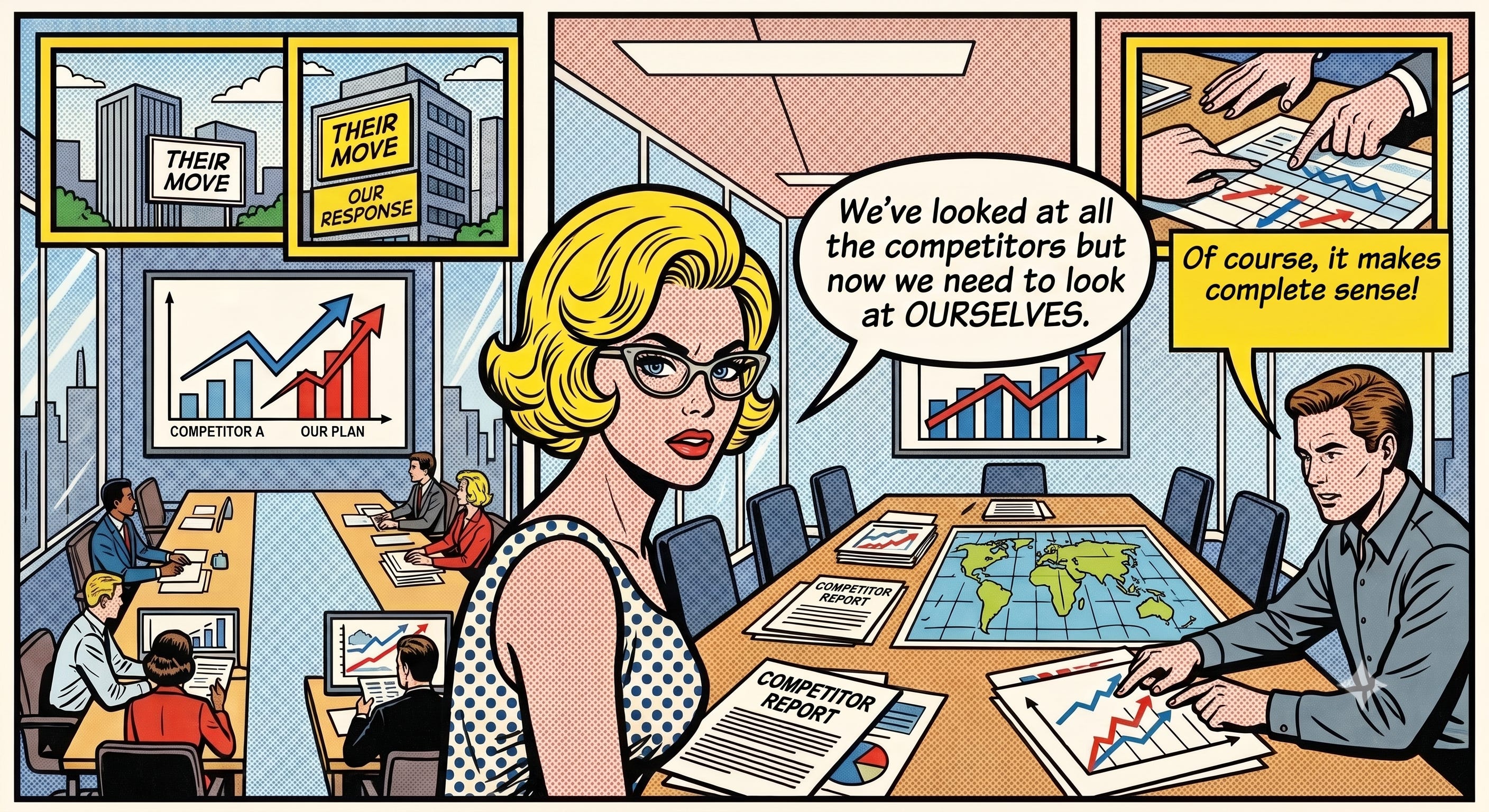
Effective competitor research does not begin with your competitors. It begins with your own organisation.
Before analysing rival websites, keyword gaps or search visibility, I always want to understand what the client believes it offers, how clearly that proposition is communicated and what audiences actually experience. The gap between those three things is often more revealing than anything found in a competitor report.
I learned this while working as an interim content strategist on a healthcare account. I had been asked to research the care home market and initially approached the task as an editor, which until then had been my main role. I read the leading providers’ websites, recorded what stood out and identified apparent gaps.
Then an SEO colleague showed me how to crawl the sites, export the data and analyse the results systematically. It changed how I approached the work. Editorial judgement was still essential, but it could now be tested and strengthened with evidence.
I’m writing about this because I believe competitor research is critical to the success of any product. It is also a lot of fun. I enjoy understanding why a brand has positioned itself in a certain way, where that positioning is working and why the organisation may not be firing on all cylinders.
Done well, competitor research gives you the evidence you need to test your proposition and map out the steps required to achieve your goals.
Here are some of the areas I always consider.
Is the proposition clear?
When I visit a website or app, I want to understand quickly what problem the organisation is trying to solve.
Many homepages do not function as effective marketing pages. The proposition may be buried deep within the site, reduced to a tagline that does not quite land or housed on a separate corporate website.
I understand that some problems are complex and cannot easily be summarised in a pithy sentence. But if you are the expert and cannot communicate your value in a way that is easily understood, why should an audience spend time trying to work it out?
What are others saying about the brand?
And when I say “others”, I do not necessarily mean humans.
What are Claude or ChatGPT saying about the brand? Where are they sourcing that information? What do review sites, Reddit users and Google results say?
The point is to understand whether the intended message is landing. Is it the right message? Does it reflect how the organisation is actually perceived? Do people care about the problem the brand says it is trying to solve?
Where are the search gaps?
A keyword gap analysis can be carried out quickly using tools such as Semrush or Ahrefs. It can help reveal how one website compares with another and where their areas of difference lie.
However, these insights should be treated as directional rather than absolute.
One of the worst things you can do is drop the results of a keyword gap report directly into a content plan. That is how organisations end up commissioning articles that may attract searches but are not properly aligned with their proposition, expertise or audience.
Optimisation for optimisation’s sake is rarely a good strategy.
What are answer engines surfacing?
Asking an answer engine a question such as “Is X a trusted brand?” can produce all sorts of revealing results.
You may discover that the shiny new corporate page containing your latest information is not the source being surfaced. Instead, the answer engine may be drawing from an old page that everyone thought had been archived years ago.
Reviewing answer-engine results can expose outdated information, inconsistent messaging and gaps between departments. It can also reveal just how siloed an organisation has become - something SEOs have been warning about for decades.
These results should not be treated as definitive measures of trust. They are diagnostic signals that help show which information is accessible, authoritative and being repeated elsewhere.
What is the client’s own audience experiencing?
One of the most useful things about competitor research is that it often highlights issues on the client’s website that the organisation may not be aware of.
Poor UX, slow-loading pages, advertising bloat and unexamined editorial workflows can all contribute to a frustrating reader experience.
This is why I take time to review the client’s website before examining its competitors. Sometimes the most urgent problems are closer to home.
Can real people complete basic tasks?
Competitor research does not always have to be expensive. Sometimes I simply ask people to visit a website and tell me what they think.
It is important to challenge your assumptions with data, but it is equally useful to test them with other people.
I used to begin content-strategy training sessions by asking participants to find the newsletter sign-up on the website belonging to the person sitting next to them. It was often an eye-opener. People quickly realised that basic calls to action could be surprisingly difficult to locate, even on their own platforms.
Has the role of video been considered?
I am not saying that video has to be part of every communications strategy. But if there is no video anywhere, that should be a deliberate decision rather than an oversight.
Competitor research can reveal whether audiences in a particular category use video to learn, compare services, evaluate products or assess credibility.
The video does not necessarily have to be about the organisation itself. It could simply be a useful resource that helps the audience understand a subject or solve a problem.
Which brings us neatly to value.
Is the value being made explicit?
Everyone talks about audience needs and value, but there is another important consideration.
In today’s attention economy, it is no longer enough to possess something you believe is valuable. You also need to communicate that value explicitly.
If your product saves people time or money, do not merely state the claim. Bring the benefit to life. What could someone do with the time they save? What frustration could they avoid? What opportunity could they pursue instead?
The same applies to publishing.
If you are a news brand, what effort went into breaking a story? What obstacles did the reporting team overcome? Why is a particular interview significant? What do its insights allow the reader to understand or do?
Never assume that the audience understands the full context or recognises the value automatically.
In Summary
Competitor research is most useful when it results in decisions, not another presentation that disappears into a shared drive.
Done properly, it can clarify a publisher’s proposition, expose weaknesses in the audience experience, identify realistic content opportunities and give teams a more confident basis for prioritising investment.
I help publishers and content-led organisations assess their positioning, content performance, search visibility, editorial workflows and audience experience.
To discuss a competitor review or content-strategy project, contact me at me@stevenwilsonbeales.com.
Related articles
The "what are Claude or ChatGPT saying about the brand" point is the one most skip. Same tool has a blind spot on the competitor side too, we unpacked it in our latest article, check it out if curious.