

I’ve always been a fan of Sistrix (and, no, this isn’t a promo piece) as its Visibility Index is a great way of seeing which sites are gaining ground, which are losing it and how publishers compare with their rivals.
Now Sistrix is turning its attention to AI search. Its new SectorWatch scorecard ranks 76 UK news brands using a mix of Google search data, AI brand mentions and citations. And already there’s a problem with assuming that conventional organic rankings tell us how visible a publisher will be in AI answers. Yes, it is a key influencing factor BUT the two just don’t line up neatly.
Let’s dive in and take a closer look.
How the score is calculated
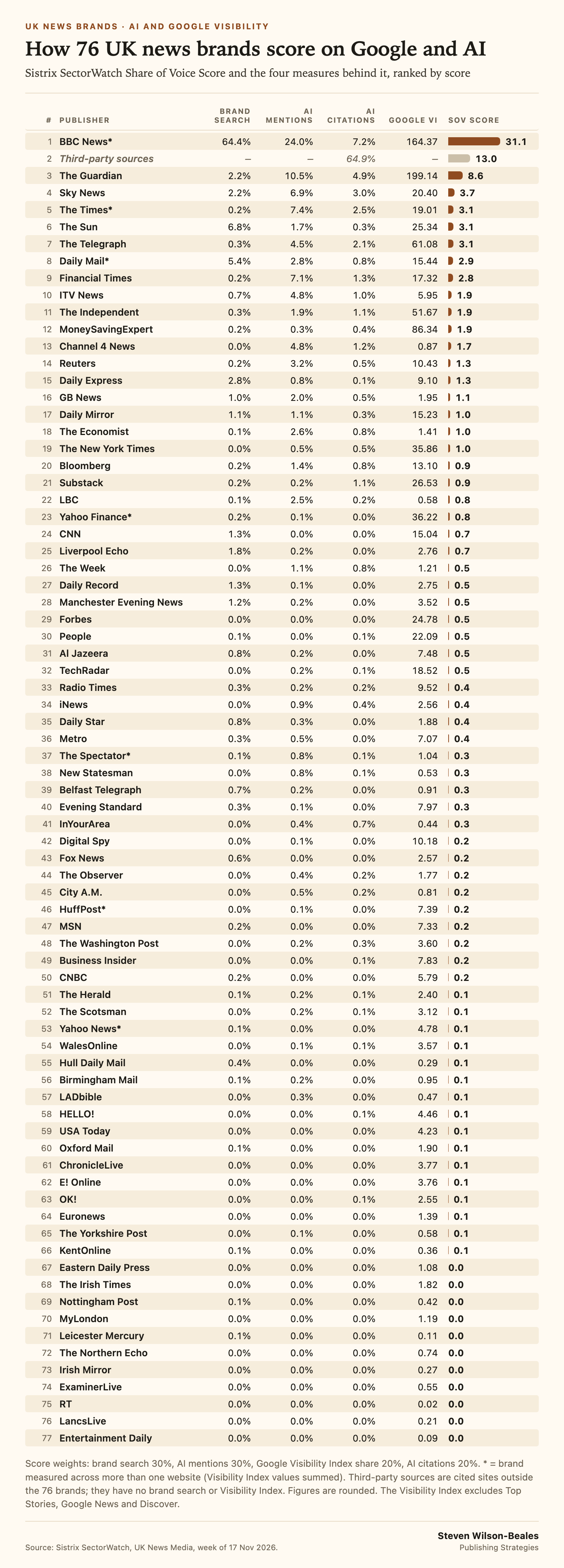
Before getting into the table, it’s worth explaining what the ranking measures. The report combines four indicators into a Share of Voice Score: branded Google search share (30%), AI brand mention share (30%), conventional Google Visibility Index share (20%) and AI citation share (20%). In effect, half the weighting comes from established search measures and half from AI.
AI citation share counts sources across the wider web, not just the 76 news brands, so the table also includes a combined ‘Third-party sources’ row. Where a publisher has multiple websites, Sistrix adds their Visibility Index values together. Scores are rounded, and movements can reflect changes elsewhere in the group as well as changes for a particular publisher.
There are two important limits to this comparison. The standard Visibility Index excludes Google’s Top Stories, Google News and Discover, so it doesn’t capture a publisher’s full Google news visibility. And the published scorecard doesn’t specify the exact AI prompts, platforms or sample sizes used. That makes the results useful for spotting differences, but not definitive measures of overall search or AI reach.
And just before we dive into that table, special mention to the Beers and SEO with Barry and Steve podcast where we discuss these insights further. Barry had some great comments about why he thinks the metric used by Sistrix here is super useful.
Sistrix UK news visibility rankings
Five things that immediately jumped out at me
1. The BBC is ahead, but brand demand explains a lot
BBC News is comfortably top with a score of 31.1. The Guardian, in third, scores 8.6. The BBC also leads the AI measures, accounting for 24.0% of mentions and 7.2% of citations. But the biggest clue to its overall lead is elsewhere: it accounts for 64.4% of searches for the 76 brands by name. With a 30% weighting, that single measure contributes about 19.3 points, almost two-thirds of the BBC’s total score.
So I wouldn’t look at that lead and conclude that the BBC has somehow solved AI search. What we’re also seeing is the pull of a very well-known brand. Getting people to search for you by name is valuable, but it isn’t the same as appearing for a subject or being cited as a source.
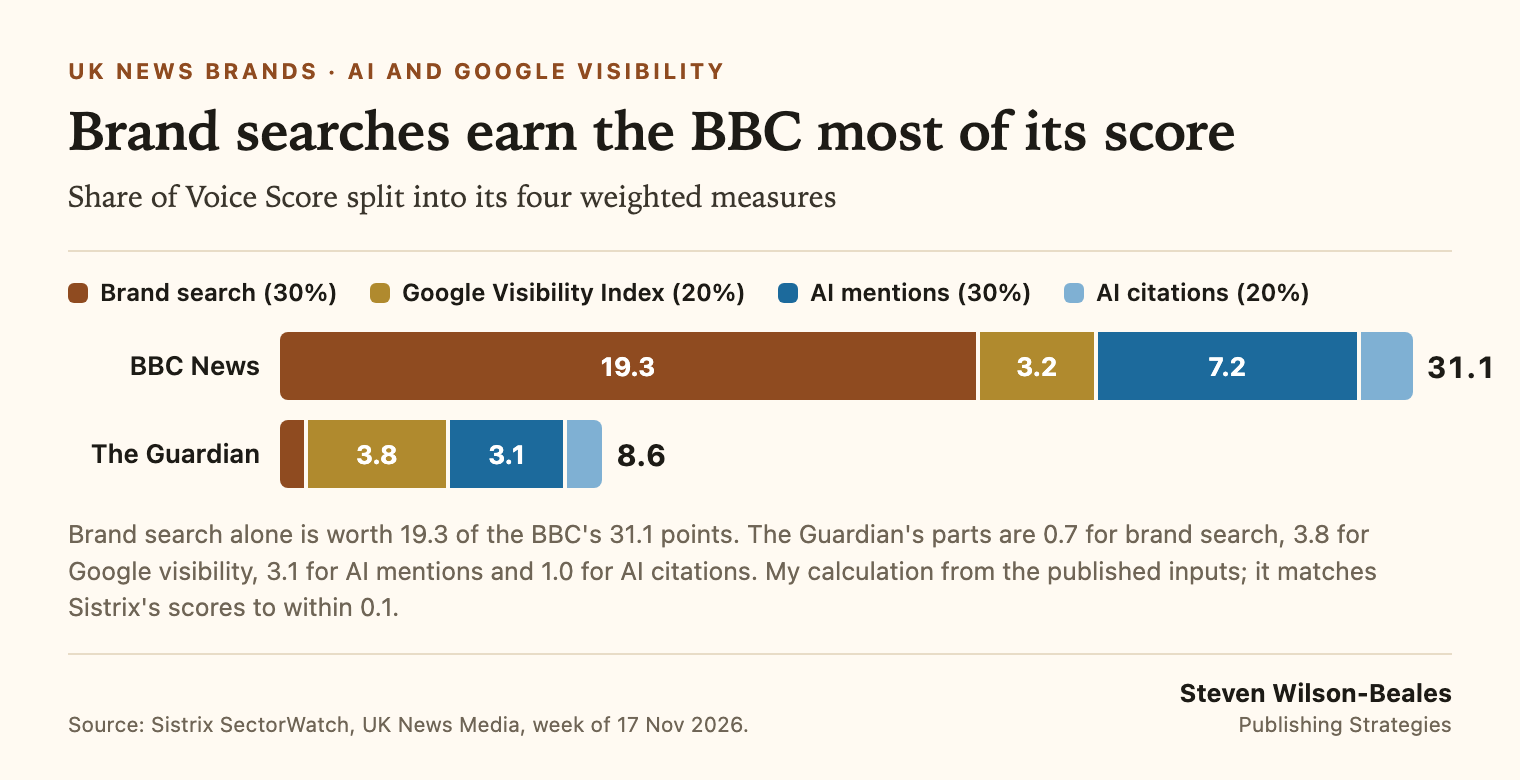
Figure 2. BBC News and The Guardian’s Share of Voice Scores split into the four weighted measures. Source: Sistrix; my calculation from the published inputs.
2. The Guardian leads on Google visibility, but the BBC leads on AI
Take The Guardian. Its Google Visibility Index is the highest in the group, at 199.14, compared with 164.37 for BBC News. Yet the BBC has more than twice its share of AI mentions, 24.0% versus 10.5%, and more citations too, 7.2% versus 4.9%.
The contrast becomes even more interesting further down the list. MoneySavingExpert has the third-highest Visibility Index, 86.34, but only 0.3% of AI mentions and 0.4% of citations. Channel 4 News has a Visibility Index of just 0.87 and still manages 4.8% of mentions, the same share as ITV News. LBC is on 0.58 for Google visibility but 2.5% for AI mentions. Of course, prompt selection may help explain some of that. A set of mainly news-related questions is unlikely to capture much of MoneySavingExpert’s strength in consumer finance.
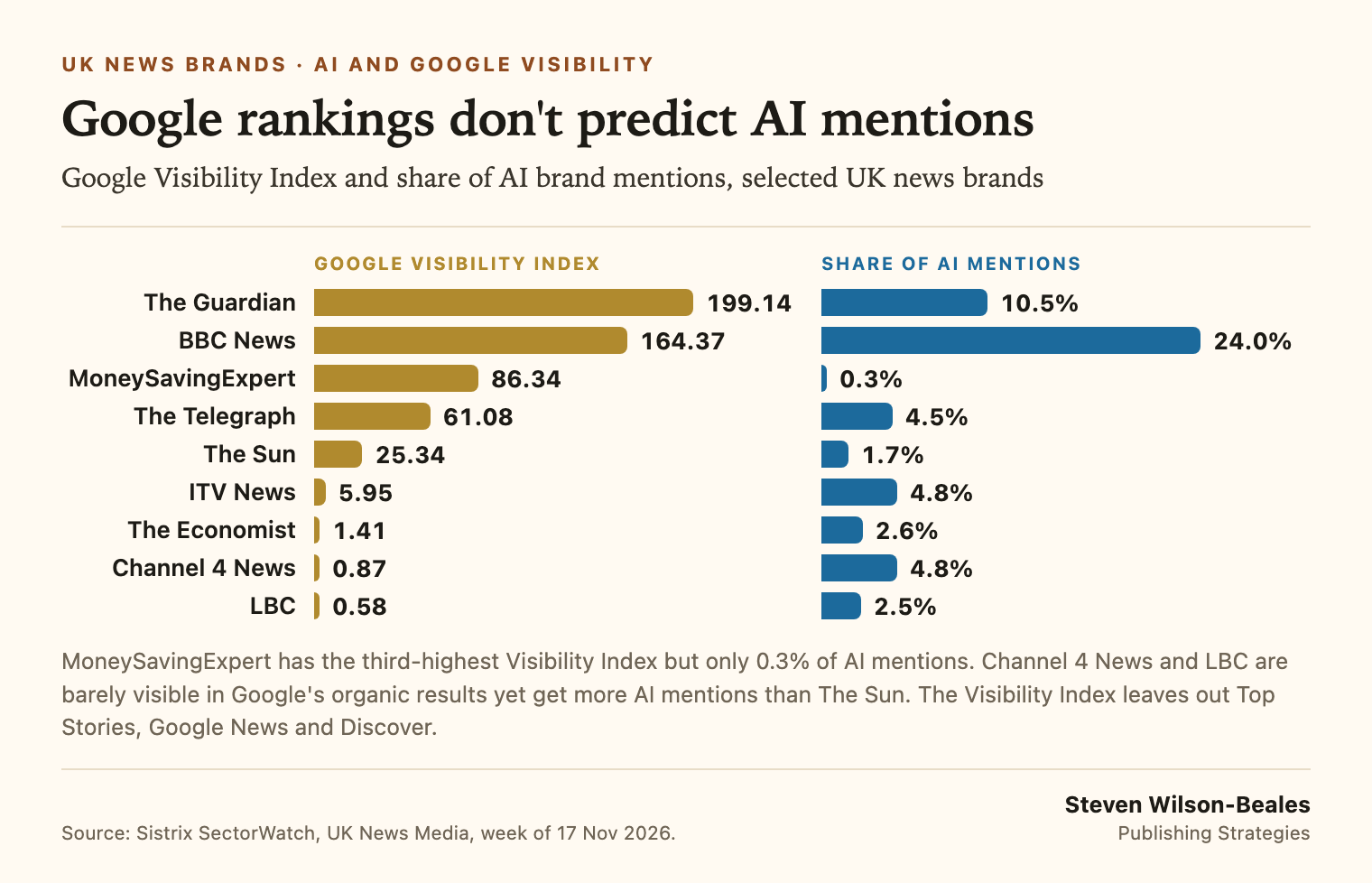
Figure 3. Google Visibility Index and share of AI brand mentions for selected UK news brands. Source: Sistrix SectorWatch, week of 17 November 2026.
3. AI assistants may mention a publisher without citing its reporting
The Financial Times accounts for 7.1% of AI brand mentions, but only 1.3% of citations. For Bloomberg, it’s 1.4% and 0.8%; for Reuters, 3.2% and 0.5%. It’s tempting to read those gaps as a failure to turn mentions into citations, but that would be wrong. The two measures use different denominators. What they do give us is a reason to look more closely at the actual answers.
Think about the difference between an assistant saying, ‘Follow the Financial Times for this topic,’ and using an FT article to support an answer. One is closer to a recommendation; the other is about evidence and attribution. I’d want to measure both. I’d also want to know whether a publisher’s original reporting is being used when the publication itself barely gets a mention.
4. The Economist gets more AI mentions than The Sun, despite lower Google visibility
The Economist is a good example. Its Visibility Index is only 1.41, but it gets 2.6% of AI mentions and 0.8% of citations. That’s a higher mention share than The Sun’s 1.7%, despite The Sun having a Visibility Index 18 times larger. We don’t know which prompts or platforms are responsible, so there’s a limit to what we can conclude. Still, it would be a mistake to treat a relatively small Google footprint as evidence that a publication has little presence in AI answers.
5. Nearly 65% of AI citations go to sites outside the 76 news brands
Here’s the figure I’d pay particular attention to: 64.9% of citations go to ‘Third-party sources’, meaning sites outside the 76 news brands in the study. That category only contributes to the citation measure, yet it scores 13.0 overall, putting it second behind BBC News. The BBC, the most-cited news brand, has 7.2% of citations.
So when a publisher asks who it’s competing with for a citation, the answer isn’t necessarily another publisher. It could be an official source, a reference site, a forum or a platform. We don’t know the mix because the chart doesn’t break down that 64.9%. For me, that’s one of the most interesting missing pieces.
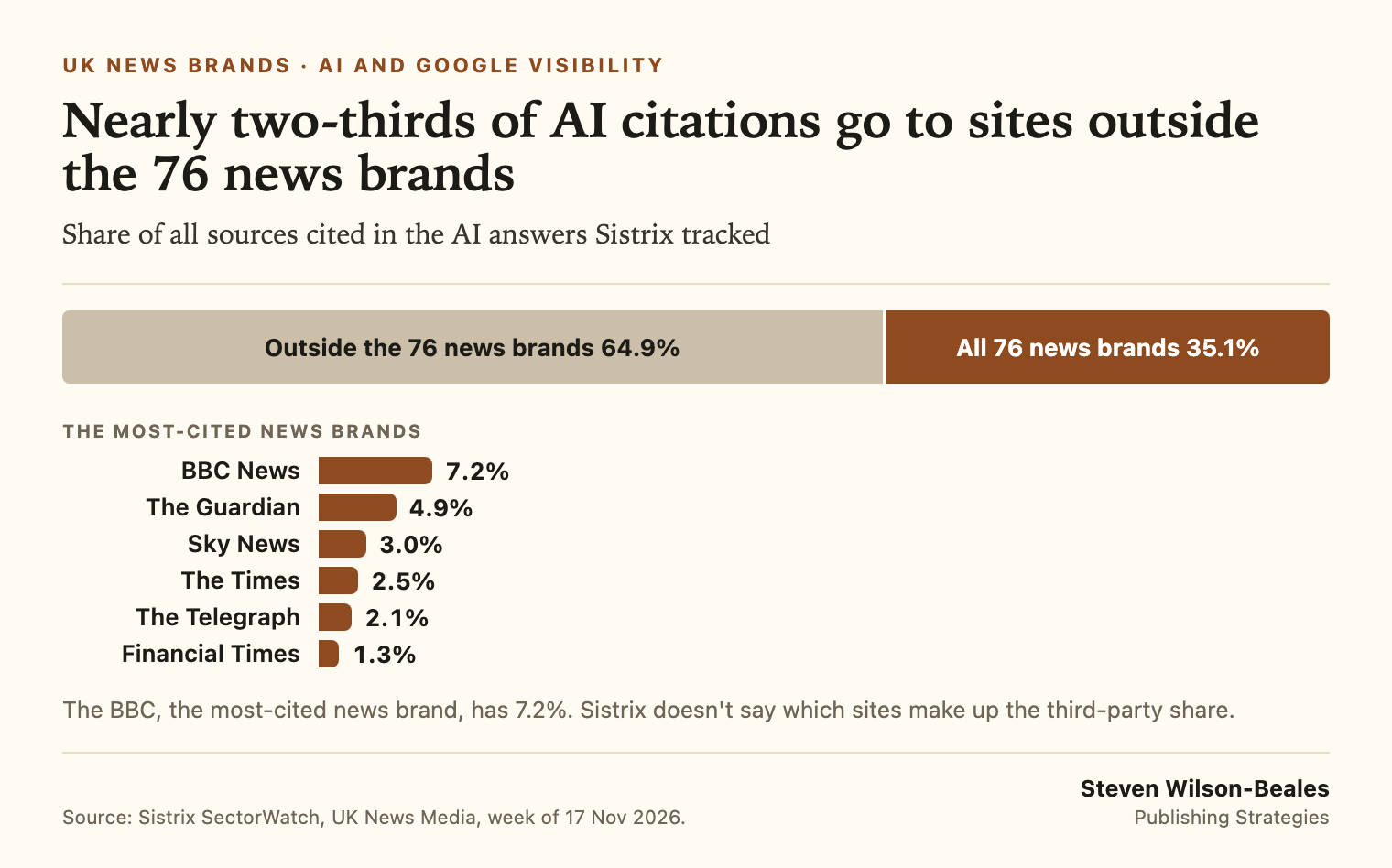
Figure 4. Share of AI citations going to sites outside the 76 news brands, and to the most-cited brands. Source: Sistrix SectorWatch, week of 17 November 2026.
Going Forward: What I’d measure alongside the Sistrix score
1. Search performance
I’d keep the established SEO measures: organic impressions and clicks, ranking visibility, branded and non-branded demand, and performance by editorial topic. For publishers, I’d also want a clearer view of Top Stories through relevant SERP monitoring, alongside Search Console data, with Discover and Google News reported separately. Otherwise we risk mistaking conventional organic visibility for the full picture of Google news discovery.
2. AI mentions and citations
Here I’d track how often the brand is mentioned, how often its work is cited, which URLs appear and who else is being used for the same questions. I’d split the results by assistant, topic and user intent. A prompt asking ‘Which publications should I follow?’ tells a different story from one asking for a factual answer. And I’d check the citations themselves. Does the linked article support the claim, and has the original reporting been credited properly?
The prompt sample needs care, too. Sistrix has argued that testing a broad range of questions is more useful than hammering away at a handful of favourites. If the sample is narrow or keeps changing, apparent movement may reflect the test rather than any real shift in visibility.
3. Reader and business outcomes
Then I’d look at what actually happens: identifiable AI referrals, engaged readers, registrations, newsletter sign-ups, subscriptions and return visits. That’s the connection to audience value. But we also have to accept what the data can’t show. If someone reads an AI answer and never clicks, ordinary referral analytics won’t capture that exposure. It might have brand value, but we need evidence before calling it an audience or commercial success.
For brands outside news, the outcomes will be different: qualified enquiries, consideration, trials or sales. The principle is the same. Appearing in an AI answer is interesting. It isn’t, by itself, proof that the appearance changed anyone’s behaviour.
And Finally…
I’m really thankful Sistrix shared the data because it has unearthed some interesting results. As I understand, this is very much a first pass and they are open to working with the news community to develop the dashboard further. I’ll keep you updated.