

I apologise in advance for this inane curiosity about Duolingo. I’m flying out to Italy soon to see Inter Milan versus Juventus with my son, and we committed to swotting up on some Italian via the app. Salve! Un caffè latte, per favore?!
My experience thus far has been a little mixed. On the one hand I’m definitely engaged and the daily newsletter alerts prompting me to commit to my daily streak haven’t annoyed me yet - so, full marks Mr. D for tone and customer engagement. But on the other hand, over 3 weeks I haven’t actually learned that much Italian? Now, that could be a big negative but I’ve done enough repeatable exercises that, I feel quite confident actually speaking it.
So, maybe, less is more when it comes to learning a language - we’ll see when we head out to San Siro!
So, Steve, what’s with the Duolingo/Newsroom love affair?
Well, if you work in publishing, you’ve probably felt the tension: readers say they want quality journalism, but their habits strongly suggest they are more inclined to spend time on apps that make returning feel effortless (and addictive). Few companies have mastered that habit loop like Duolingo—and its growth gives us a useful reality check on what “engagement” can really look like when product, tone, and incentives are all aligned.
By late 2025, Duolingo reported 50.5 million daily active users and 135.3 million monthly active users (Q3 2025), alongside 11.5 million paid subscribers. That’s not just scale; it’s frequency. There’s no denying it - 50.5 million daily active users is BONKERS.
And the momentum isn’t a one-quarter wonder, either. In its 2024 annual filing, Duolingo reported 116.7 million MAUs and 40.5 million DAUs in Q4 2024 (three months ended Dec 31, 2024), up sharply year-on-year, with 9.5 million paid subscribers at period end. In other words: it has built a routine product that tens of millions choose to open every day.
So what can newsrooms borrow from its success, without trashing quality journalism altogether?
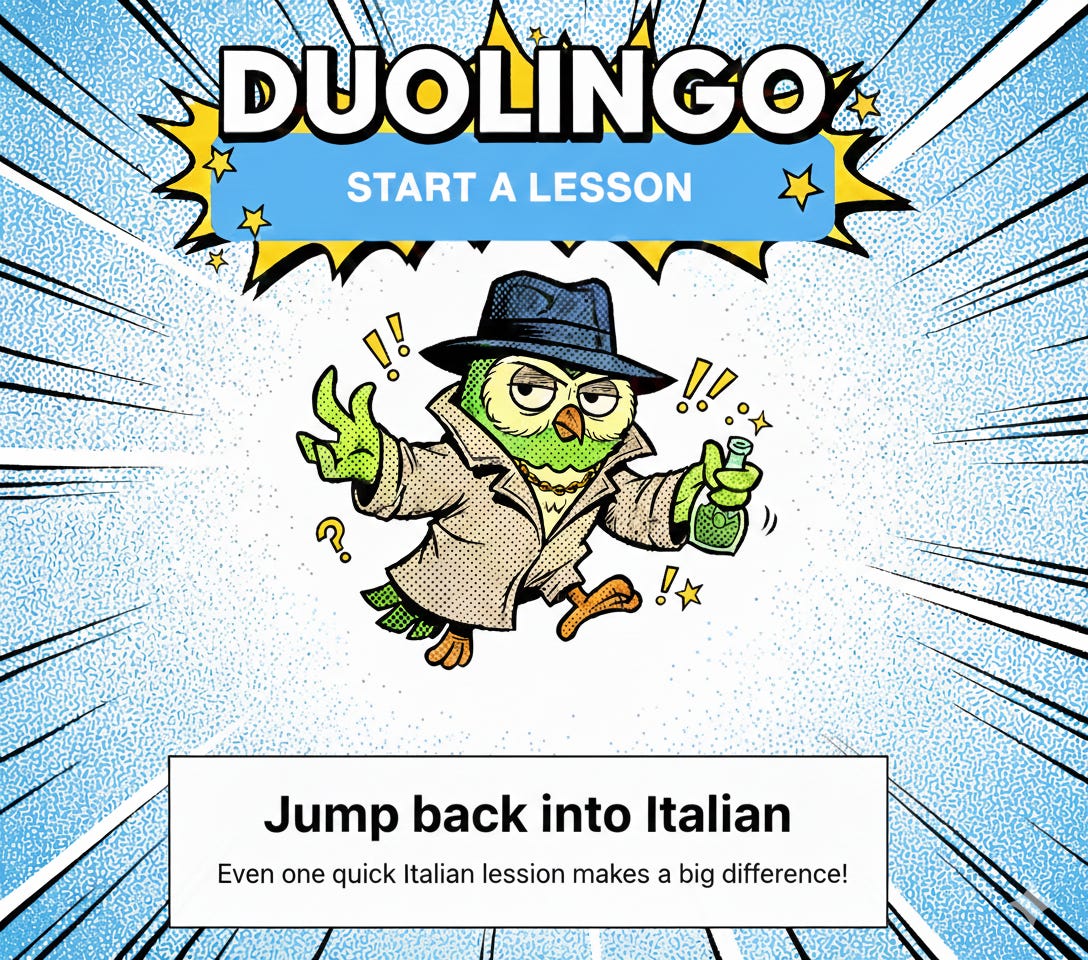
1) Design for “small wins,” not heroic sessions
Duolingo doesn’t ask for an hour. It asks for a lesson. Then another. Then—oops—you’ve done ten minutes.
Newsrooms often design like every visit should be a banquet: big investigations, long reads, feature packages. Keep those but add more “small wins” that still respect the craft:
A two-minute “what changed since yesterday” update on a beat
A “one chart, one takeaway” daily post
A short explainer that closes a single knowledge gap
In short, make it easy to start and satisfying to finish. Completion is motivational fuel. Edition-based digital publishing was soooo 2020, we’re now talking micro-editions, baby.
2) Streaks are really about identity and continuity
The infamous Duolingo streak isn’t just gamification; it’s a promise: “I’m the kind of person who shows up.” Duolingo’s filings even call out efforts to make the product “more social and engaging” as part of growth in active users.
Newsrooms can create continuity via:
Reading streaks tied to topics (e.g., “Local news streak,” “Climate streak”)
“Follow” author/story features that turn a beat into a relationship
Save-and-return affordances: “Continue where you left off” for ongoing stories
The point isn’t about gaining endless gamification points. It’s about helping the reader build a repeatable habit and a sense of “this place is mine.”
3) Personalisation that feels like service, not surveillance
Duolingo personalises the journey: you’re placed, guided, nudged, and shown progress. The newsroom equivalent might look like:
Let readers pick 3–5 interests at onboarding (“UK politics,” “Premier League,” “Housing,” “AI at work”)
Build “Your Week in…” digests from those choices
Offer “light / standard / deep” modes for the same story (summary → context → full piece)
The lesson here is personalisation works best when it’s transparent (“you chose these”) and reversible (“change topics anytime”).
4) A brand voice people want to hang out with
Duolingo’s tone—especially on social—has become part of its product. The company even notes it adjusted “unhinged” social posting in response to community feedback, then saw impressions rise again after increasing it. That’s a sophisticated point: tone of voice is a retention lever, but it must be managed like any other—tested and adjusted on feedback.
For publishers, “friendly” doesn’t mean flippant. It means:
Clear, human headlines (less institutional throat-clearing)
Occasional wit where appropriate
More “here’s what you need” and less “as readers will be aware”
Informative and friendly is the key here.
5) Measure what Duolingo measures
Duolingo reports DAUs, MAUs, and paid subscribers because those reflect habit and value exchange. Newsrooms often focus on page views that don’t map to loyalty.
A Duolingo-inspired dashboard for publishing might prioritise:
Days-per-month active (are people returning?)
“Followed topic” engagement (are relationships forming?)
Completion rate (are stories built to be finished?)
Subscription starts per engaged cohort (not overall traffic)
The bottom line
Duolingo’s popularity isn’t magic. It’s the compound effect of low-friction starts, visible progress, friendly tone and a product that respects the power of daily routine. Journalism can’t—and shouldn’t—copy the dopamine tricks wholesale. But it can learn from the discipline: design for repeat visits, make progress legible, and treat engagement as a long-term relationship, not a one-night casual user stand.
In making this list I haven’t been able to shake that voice inside which says ‘Steve, there is absolutely NO WAY newsrooms are going to sign up to a Duolingo-like model.’ I think that’s because the tone of voice for this brand is just so prevalent. The real question being asked here is: can a news brand for adults ever be irreverent, friendly and - damn it - even fun?
“But Steve, just look at newsrooms on the socials!” I hear you cry. But that’s not really the answer. So many news brands on social seem to be personable and friendly, but when you hit their website or app, it’s back to the NO FUN HERE brigade and serious faces. As a punter, I’ve always found that slightly jarring.
I think the truth here is that everyone will say no to a ‘Duolingo for News’ until they see a successful prototype. Axios was short and snappy, The Know was fun and informative. UsVsTh3m was on the right track. I think we can do even more. Time to get the Python manual out.
Grazie per Aver Letto!
PS: If you are an italian speaker, I was recently interviewed about Zero click search right here.
Related articles