

This guide is based on my work with clients on podcast strategy and PSO — Podcast Search Optimisation — as well as what I’ve learned through my own, humble podcasting endeavour. What I’ve discovered is that often podcasts struggle because teams treat optimisation as post-production. In this guide, I’ll share how I help brands and publishers build podcast strategies around audience needs, discoverability and measurable growth from the start.
Why start a podcast?
There are many reasons why you might want to start a podcast, and with more than 4.7 million listeners worldwide, that’s a pretty impressive audience! But with 342,000 podcasts being uploaded in the last 30 days alone, how can you possibly expect to cut through? And with the advent of AI and podslop you might be forgiven for just calling the whole damn thing off.
However, and somewhat ironically, now that AI summaries and chatbots are here to stay, it’s never been more important for brands and publishers to prove their authority. A good podcast can do something an AI-generated summary can’t: build trust, demonstrate expertise and create a direct relationship with an audience.
Audio audiences are also fiercely loyal, but discoverability remains a major challenge. So how do you build a podcast that people can actually find, understand and return to?
The Three P’s of Podcast (and Video) Optimisation
If you’re already seeing flat downloads, poor retention or limited discovery, this is usually where I start with clients: Product, People and Promotion.

Product: why the show exists, what it offers and how it is structured
People: how audience insight shapes the proposition, format and content
Promotion: how you make the show discoverable across podcast apps, search, social, video and owned channels
Each of these three areas is important, and they often overlap. A lack of focus in any area will result in diminished success.
Product
I’ll be blunt: promotion cannot rescue a fundamentally unclear podcast proposition. No amount of social media promotion, clever cover artwork or SEO’ing is going to elevate your podcast if the way the ‘product’ is conceived is fundamentally flawed. Well, actually, that’s a bit of a lie. Some successful podcasts do have obvious flaws but many are supported by major PR, talent or marketing budgets. Do not copy what they do blindly just because they are already at the top.
Setting Goals
I asked a number of podcast producers why some podcasts fail and they all agreed - it’s because the why and the who of the product was never identified. In other words the following was never asked:
Why are we launching this podcast now?
Who are the listeners and what needs are we satisfying?
Why should the audience want to listen to our podcast above our competition?
Setting a clear goal for your podcast is the No.1 priority before you do anything. Of course, not all goals are good goals, a poor goal can cause a lot of confusion and a waste of resources. An example of a poor goal might be ‘raise as much awareness of our brand as possible’ or ‘generate as many leads as possible.’ They are weak goals because they are vague — and vague goals usually lead to vague results.
A good goal should state the problem and how you are going to resolve it. The more specific you are when creating goals, the better the outcome will be for everyone, including the listener.
This might sound all rather complicated but you can quickly start addressing these questions by simply reframing the problem like this:
Instead of writing: ‘We want to publish a podcast about X because….’
Write this: ‘Our audience needs a podcast about X because….’
(Thanks to Chris Stone for that reminder. Our UX brethren would say LEAD with the NEED.)
That’s why I always say that creating a podcast is not about creating a marketing ‘add-on’, it’s all about creating a brand with its own identity and purpose. Having a clear idea of that will really help with all the messy questions that soon rear their head when you start producing podcasts. Questions like…
What is the ideal length of a podcast?
Well, the general rule of thumb is the more frequent the podcast, the shorter it can be, whereas less frequent shows can often be longer. But that’s all poppycock without a clear understanding of what your audience exactly wants and are used to. The key really with podcasts is to create consistency with your output so you become part of your audience’s habitual routine. That’s why changing the format or schedule can really annoy listeners - unless you are transparent and explain why. If your interview with a guest takes half the amount of time a guest usually takes, don’t feel obliged to pad out your podcast for the sake of padding it out. That way ends in madness and dwindling audience retention. Which brings us neatly to…
What are the metrics that matter in podcasting?
Many publishers cite downloads as a key metric for their podcasts but if they are not careful, this can soon become a vanity metric. A download doesn’t equate to a listen. There’s quite a few metrics you could look at but nothing is more humbling than audience retention. If 60% of your audience are dropping off after 5 minutes, you have a problem which could be down to many things including the lack of…
…Story Arc
Having a narrative structure in some shape or form is one of the best ways of attacking low audience retention. You need a clear Beginning, Middle and End and in amongst that a whole series of promises and pay-offs. Clarify the problem you are going to resolve at the start and then launch yourself into the main section. Maintain audience attention by introducing something different at any point you think the audience might zone out. Hang that open loop in the air so listeners can’t wait to reach the end when the whole story arc is resolved. End with a recap, a big thanks and a possible tease to a future episode. Simples?
Of course, I’m doing 3,000 years of storytelling a huge disservice here but you get the idea. How you tackle your story arc/s is flexible, but you need structure otherwise you’re going to ramble, meander and ultimately bore.
Speaking of which…
+++++++++++++++++++++++++++++++++++++++++++++++++++++++++++++++++++++
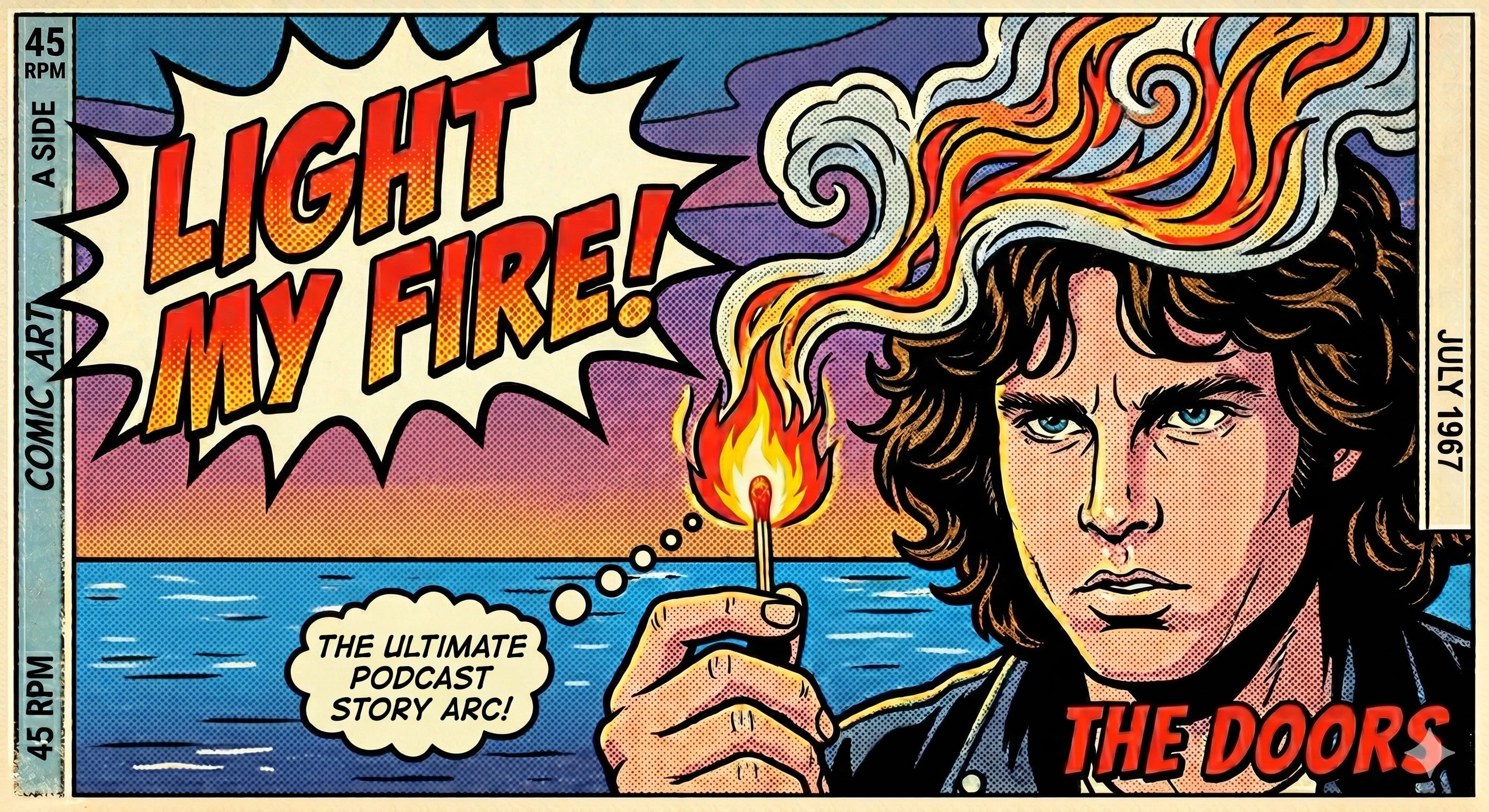
A quick story-arc detour: I once realised while listening to “Light My Fire” by The Doors that the song works almost like a podcast structure: a clear opening promise, an extended middle bit (question and answer solos) that maintain attention, and a return to the original motif for resolution. The lesson for podcasts is simple: even when you wander, the audience needs to feel there is a shape.
++++++++++++++++++++++++++++++++++++++++++++++++++++++++++++++++++++++
When podcast formats can work against you
Something I’d also mention is that while structure and format are essential, I’ve often seen podcast growth plateau because the format becomes too restrictive. A show might take off because it has two funny people talking about funny, interesting topics — what’s not to love? But if the team is unwilling to explore new subjects, bring in different guests, or broaden the creative scope because they have a rigid idea of what the format “should” be, that can quickly lead to stagnation.
This often becomes more obvious when a podcast moves onto YouTube. Video opens up a whole world of cross-promotional opportunities, especially around guests, collaborations, clips and visual formats. But teams can struggle to take advantage of that if they’re too attached to the original audio-first structure.
Of course, there’s a difference between “can’t” and “won’t.” Another reason podcasts stagnate is good old-fashioned office politics. Sometimes it’s a power play; other times it’s restrictions from the brand police. If you hit that kind of roadblock, my suggestion would be to influence through data so your arguments feel less subjective. Do plenty of competitive research, and be ready to explain why other brands in your niche have been able to grow by taking a more flexible approach.
Most importantly, take the time to understand the objections. Maybe the team simply wants to focus on audio. Maybe they’re not interested in video, or they don’t have the resources to support it properly. And that’s fair enough. But understanding the real reason behind the resistance will help you work out whether the format is genuinely protecting the show — or quietly limiting its growth.
People
By people, I mean audience and by audience I really mean ‘What do people really need in their lives?’ There’s lots of podcasts that I listen to that give me what I want - an update on this or that - and they have their place. But the podcasts that sit in my library and are often re-listened to are those that always answer the ‘Why’. Essentially, I’m not looking for breaking news updates, I want comment and analysis - ultimately making sense of what’s going on and how it impacts my life. So how do you find out what people actually need?
This may be a little repetition of Product but essentially, you want to be very clear about the audience and your niche, as well as look for a gap in the market. Ask yourself:
Who is the audience?
What do they struggle with?
How will your show help them?
Why should they listen to you over anyone else?
If I was going to launch a show tomorrow on, say, ‘Gardening Tips 101’ I would be spending time researching what challenges the audience faces in this area. Reddit, Google Trends, YouTube, X are all good ways of really drilling in along with a multitude of SEO research tools. But you do need to try and understand the audience’s need behind the questions being asked online.
For instance, with enough time I would soon realise that although ‘gardening tips’ might make an excellent podcast search optimisation title (more on that later), the real issue facing gardening in the UK (where I live) is the changing climate and how it’s throwing traditional horticultural timelines out of whack. With more random weather patterns, how do you adapt as a gardener? That’s the real need which your podcast must address. It doesn’t have to be explicit, you can still talk about the best time to plant a daffodil, but you must identify the underlying need to make your podcasts compelling and relevant.
I’m mentioning Audience Needs a lot and that’s because I’m a big fan of the Audience Needs model proposed by Dmitry Shishkin. The basic idea is that audiences do not simply want “content”; they have specific needs — to be updated, informed, inspired, connected, distracted or helped. Digital Newsrooms have been using this model for yonks and is a great way to think about the various reasons why someone might want to listen to a podcast in the first place. Adapting this model somewhat you could arrive at the following needs for podcasts which might include:
I want the latest updates
I want the wider context
I want to be inspired
I want to be part of a like-minded community
Sigh, I just want to be distracted from what’s going on in the world
You might be able to think of many more needs when it comes to podcasting. You could add different audience ‘moods’ for instance or consumption habits i.e. what the listener is actually doing when listening to a podcast…which, for me, is often running up some random hill and back again.
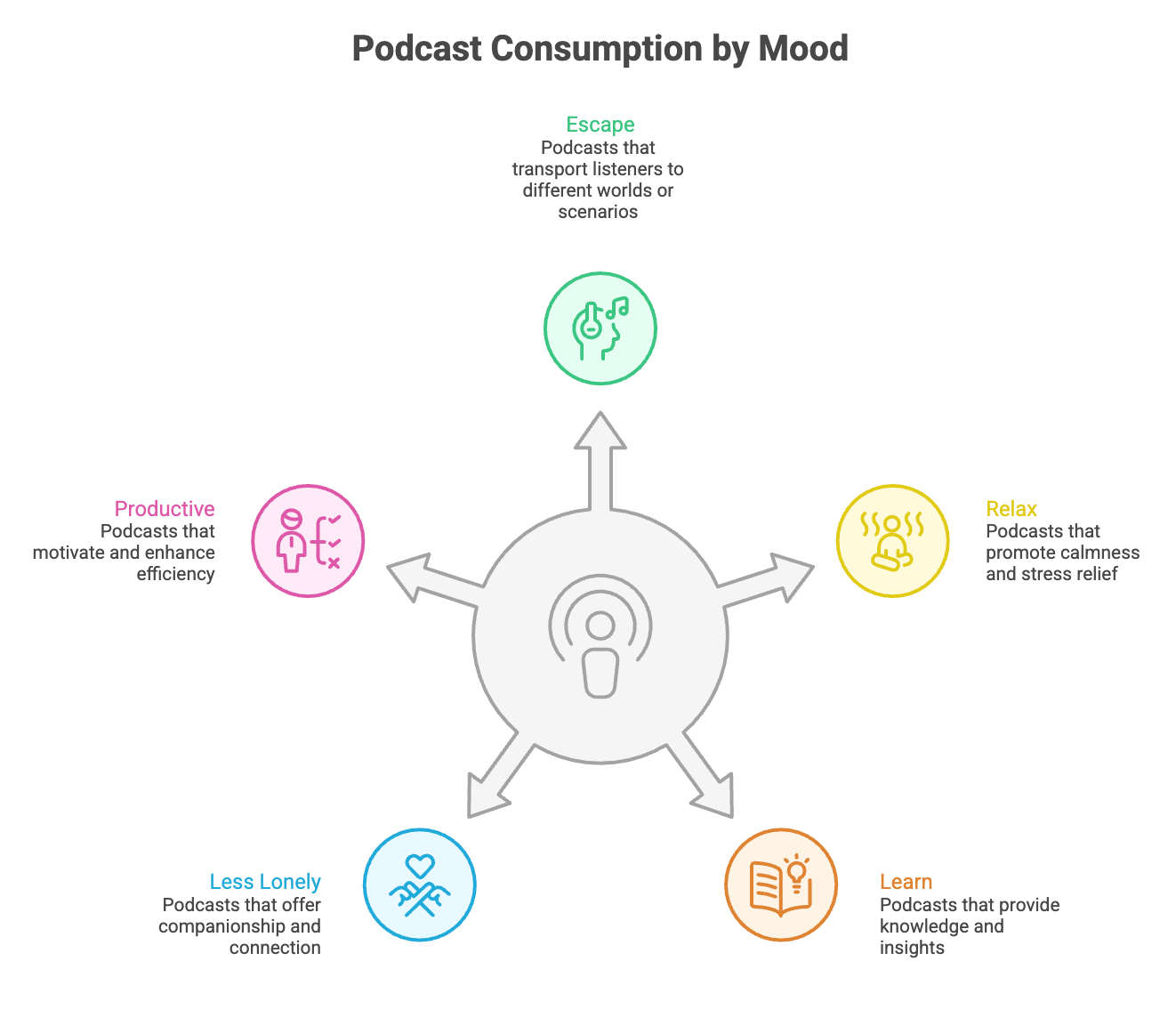
You might also have audience needs that are less abstract and more data-driven. Your ideal audience might exhibit certain behaviours that you’ve identified through your first party data, for instance. It’s not uncommon for businesses to adapt the definitions here based on their own internal language or unique audience insights. Just make sure that you are actually identifying a real audience need and not projecting your own unconscious bias which sometimes happens when companies attempt audience personas. The answer, at the end of the day, is always speak directly to your audience to get the best insights.
In addition to audience needs you also need to do a decent amount of competitor research. Do you know what the most popular shows are in your niche? Go into the podcast sections of Apple and Spotify right now and type in the keywords you think are most applicable. You will see quite a few surprises. Like any form of competitive research, try and work out why the top podcasts in your niche rule the roost. Look at the cover art, titles, descriptions, formatting, guest interviews etc. But most important of all - take time to listen to them. You’d be surprised how many people don’t actually do this. Which brings us to…
Promotion
There’s no point in creating a podcast if no one is going to listen to it, and if you’ve followed everything above then you will have mitigated many of the problems that sometimes happen when it comes to podcast promotion. However, discoverability is still quoted as a major challenge to podcasters, so let’s look at some of the ways we can make this easier.
Like any digital marketing campaign, defining precise attribution to a specific acquisition channel can be more than a little tricky particularly when it comes to podcasts. Potential listeners might have seen a video on TikTok, followed a recommendation from a friend or read a review before they decide to actively search for a podcast on a platform. That’s why it’s useful to keep track of the latest audience consumption reports so you can understand which platforms to prioritise depending on your own unique circumstances.
For instance, according to Riverside, 50% of podcast listeners find new podcasts through their podcast listening app; 31% of listeners find new podcasts on YouTube, followed by Spotify (24%) and Apple Podcasts (12%). Additionally, 55% of podcast listeners say that they get podcast recommendations from people they know (word of mouth).
The recent Reuters Institute report on podcasting is also a worth-while read when it comes to consumption trends:
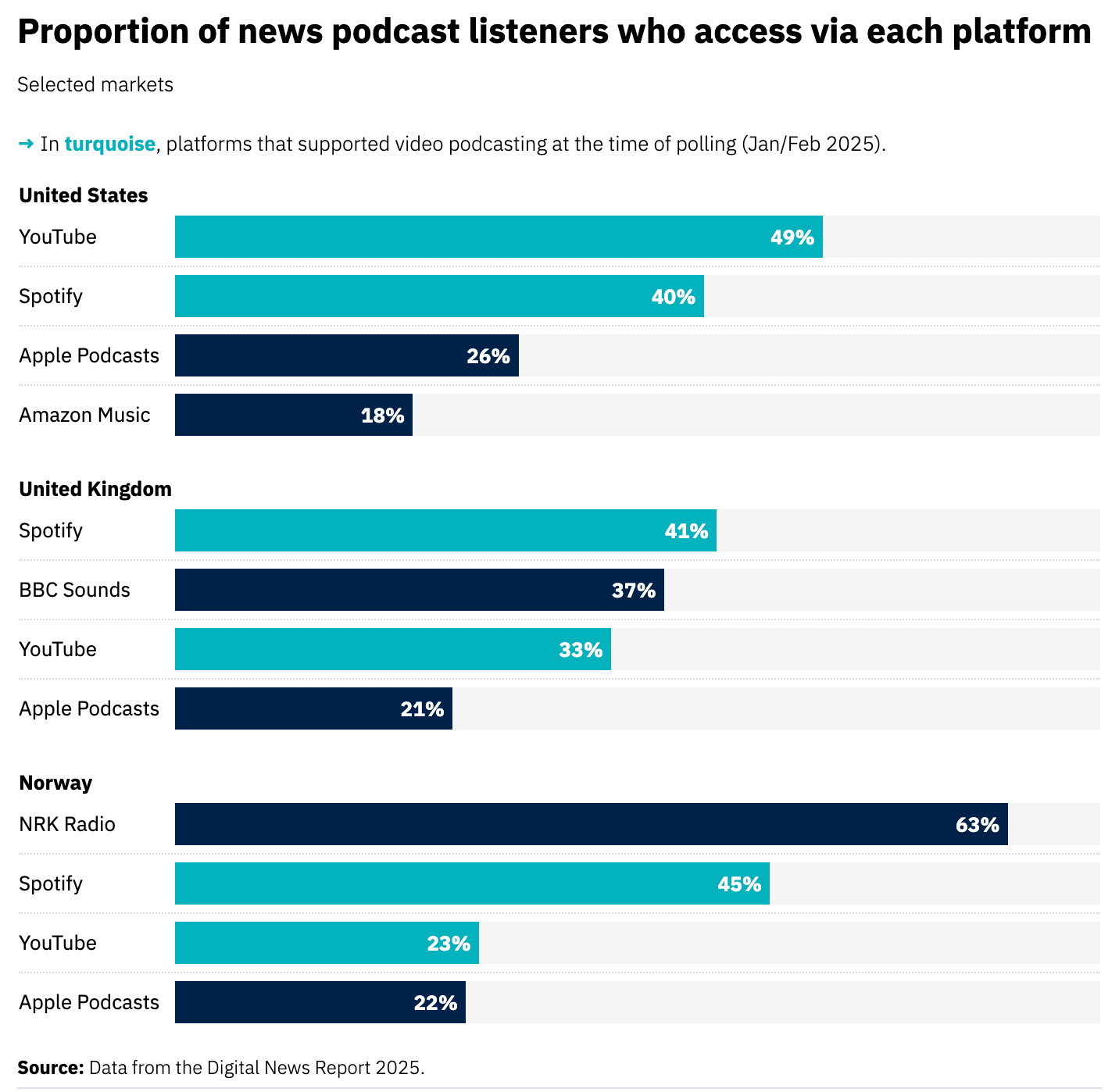
Based on this, be prepared to target a wide range of promotional opportunities which might include (and are not limited to): social media clips, community engagement (Reddit etc), YouTube, podcast app discovery (otherwise known as PSO or Podcast Search Optimisation), SEO, PR and paid ads.
As I started this whole guide initially by looking at PSO, I’ll start with that.
Podcast Titles and Descriptions
In podcast audits, one of the most common issues I see is that the show title, episode title and description are all doing the same vague job. None of them clearly explains who the episode is for, what problem it solves, or why it deserves attention now.
When launching a new pod I think it’s entirely reasonable to tweak and experiment with titles and descriptions - don’t assume you can’t re-edit once you’ve published. There are tools out there that can help you with this but it starts by understanding how the two main podcast platforms - Apple and Spotify - actually promote podcasts.
Those two platforms are slightly different in how they surface podcasts. Apple still places significant emphasis on editorial curation, while Spotify leans heavily into personalised and algorithmic discovery. It’s always well worth understanding how a show appears and is promoted in each environment.
Always check how the title and description are displayed, how the text gets truncated or cut off. Just like classic SEO, identify the primary and secondary keywords. Make sure the primary one is included in the title where possible. Ditch the wit and pinpoint the key topic/entity/person being discussed. Make sure your descriptions fill more than one line and don’t overboard with keywords. Be kind to your audience and take time on this part. You won’t be disappointed.
Podcast titles need to create a curiosity gap that doesn’t disappoint. A bad curiosity gap is really just a form of clickbait which overpromises and under-delivers. Clickbait titles are probably the quickest way of killing a show so proceed with caution.
There are a couple of decent ‘PSO’ tools out there that can help but do you REALLY need them? Well, I think it might depend on your objectives. I’ve certainly found they have helped highlight competitors I wouldn’t have checked out before so, in that way, they had sped up my workflow.
Once you are in this world of optimising podcast titles and descriptions then you might find yourself a mere skip and jump away from using tools like Claude or ChatGPT to assist you. Just be warned that AI generated text can really suck. In most cases, I’ve ended up writing copy myself.
Treat cover art in the same way as you might treat a social media thumbnail. It must be simple and easy ‘to get’. Does the image support the show’s main thesis even if that thesis is ‘A podcast on tax avoidance can be fun!’ Look at what your competitors are doing, create a Miro board with all your options to discuss with your team.
Should my podcast also be on YouTube?
I get asked about this a lot and my answer is ‘yes’ - but you need to understand what it entails. YouTube offers so many great benefits, extending your audience reach and providing you with all the data you could ever want. Just be mindful that video and audio audiences are not the same. There is a reason why audio CPMs are much higher than YouTube CPMs - and that’s because engagement is longer in audio for podcasts. In addition, once you start optimising for YouTube, you’re going to start doing things you may not have considered when you were primarily working with audio. For instance, if you’re not careful you can get quickly sucked into creating endless YouTube Shorts with no apparent benefit.
As Grace Jones once sung, don’t be a ‘Slave To The Algo-Rhythm.’
Sorry.
Another thing you may need to consider is switching on a camera is not the same as switching on a mic. Recording audio between two people can unearth wonderful intimate moments of absolute honesty - a key reason why people are drawn to podcasts in the first place. But switch on a camera and all of that can quickly evaporate as the dynamic changes. So be intentional when recording video and adapt if the conversational tap begins to run dry.
Lastly, think about the visual identity of your show which is as significant as the actual content. It’s an old adage but it’s true - the setting can often be the ‘main character’ of your production. Not that every video podcast needs to look like a scene from Tolkien’s Rivendell, you just need to consider how the surroundings can play a part along with any graphics that might accompany the show.
So is video essential? No, but it can help, as well as send you into a complete tangent.
I’ve previously mentioned that video clips are a great way of promoting your show. The cost of producing these clips has massively decreased with tools like Riverside, just make sure that the output is exactly what you want. Automated clipping tools don’t always select the best segments of your podcast conversation. Only YOU are the judge of that so don’t outsource that decision to a tool.
As DigiDay reported recently be careful not to alienate your audio listeners if you are also embracing video. There’s been far too many examples of presenters holding up something to the camera and talking in a way that excludes an audio listener. I should know, I’ve done it myself. Never make your audio listeners feel like an afterthought.
Does my podcast need a website?
I would say, all things being equal, yes. A website gives your podcast a single owned destination: a place for show notes, search visibility, email capture, analytics, listener feedback and conversion journeys. If resources are tight, even a simple landing page is better than scattering every call to action across different platforms. You might even want to use linktree. Just make it’s easy for your audience to find you and give feedback.
In Summary
Thanks for reaching this far. I hope I haven’t taken all the fun out of podcasting with talk of titles and descriptions but I hope I’ve demonstrated that Podcast optimisation is not a checklist you apply after publication. It is a way of designing the show so that the right audience can find it, understand it, trust it and keep coming back.
If you’re planning a new podcast, struggling to grow an existing one, or trying to understand how audio and video should work together in your content strategy, I can help.
I work with brands, publishers and content teams on podcast strategy, podcast search optimisation, audience insight and promotional planning.
Get in touch at me@stevenwilsonbeales.com and I’ll happily talk through where your podcast may be losing audience — and where the biggest growth opportunities might be.
++++++++++++++++++++++++++++++++++++++++++++++++++++++++++++++++++++
I’ll also be joining the WTF is SEO? Spring Community call to discuss all things podcast SEO on Wednesday, May 20 at 11 a.m. ET/4 p.m. GMT. Register here to receive a reminder and ask a question. See you there!
+++++++++++++++++++++++++++++++++++++++++++++++++++++++++++++++++++++
Related articles