

Yes, I know, maybe I could have selected a better name for this new series of substacks but I’ve always been a big fan of Smart Brevity™. Each week I’ll take a look at the top digital audience growth stories that caught my attention.
Let’s get to it.
Actually before we start I want to send my heartfelt support to the staff that were recently laid off at The Washington Post. This has sent quite a shock through the media industry and the rationale is covered in detail on the excellent Media Confidential podcast by Alan Rusbridger and Lionel Barber. The WP is an excellent publication and I was always impressed by their in-depth sports coverage.
Just in case you weren’t aware, Google is rolling out a Discover core update, the first one of its kind which has been officially announced. Limited to the US for now, it aims to prioritise locally relevant content based on a user’s country while reducing sensational and clickbait content. This will be really interesting to see, because - well, (1) with Google there’s always a gap between what’s announced and what actually happens in the SERPS and (2) newsrooms around the world have been optimising like crazy to create ‘curiosity gap’ content that OFTEN verges on the sensational only because Google rewarded them with visibility in the first place. Expect audience growth specialists to be watching this like hawks but, like I’ve always said - treat Discover with caution, it’s a tactic, not a long-term strategy.
Elsewhere, I really loved this great video by Marie Haynes showing how engagement signals (via Glue/Navboost) are so important for rankings. That might sound pretty dry but Marie is an excellent communicator and I found myself ‘glued’ as she took me through Google legal trial documentation to unearth info on Rank Brain, Rank Embed (BERT) and vector search. She has already written about this in more depth here. After watching the vid, I feel more clued up on the link between engagement and ranking, why and how often Chrome user data is used, and why ‘chunking’ your content may work now for AI, but in the long-term you should be focusing on super-serving your audience with helpful content.
And that doesn’t necessarily mean in chunks.
It could mean quirky things like this sentence
that is not a chuck, in any shape
or form
.
In other news, specifically GB News, Press Gazette have released another chart looking at the 50 biggest news sites in December. Perhaps, we shouldn’t really be surprised about the rise of Substack (I mean, everyone has one now, right?) but the performance of GB News has been nothing short of a digital success story - even though it pains me somewhat to admit it as a left-leaning poet personality type who wouldn’t have fared well in Stalin’s Russia.
(Sorry, my son is doing A Level History exams atm, so we’re reliving Stalin’s Forced Collectivism circa 1928. In short, poets ALWAYS get a raw deal.)
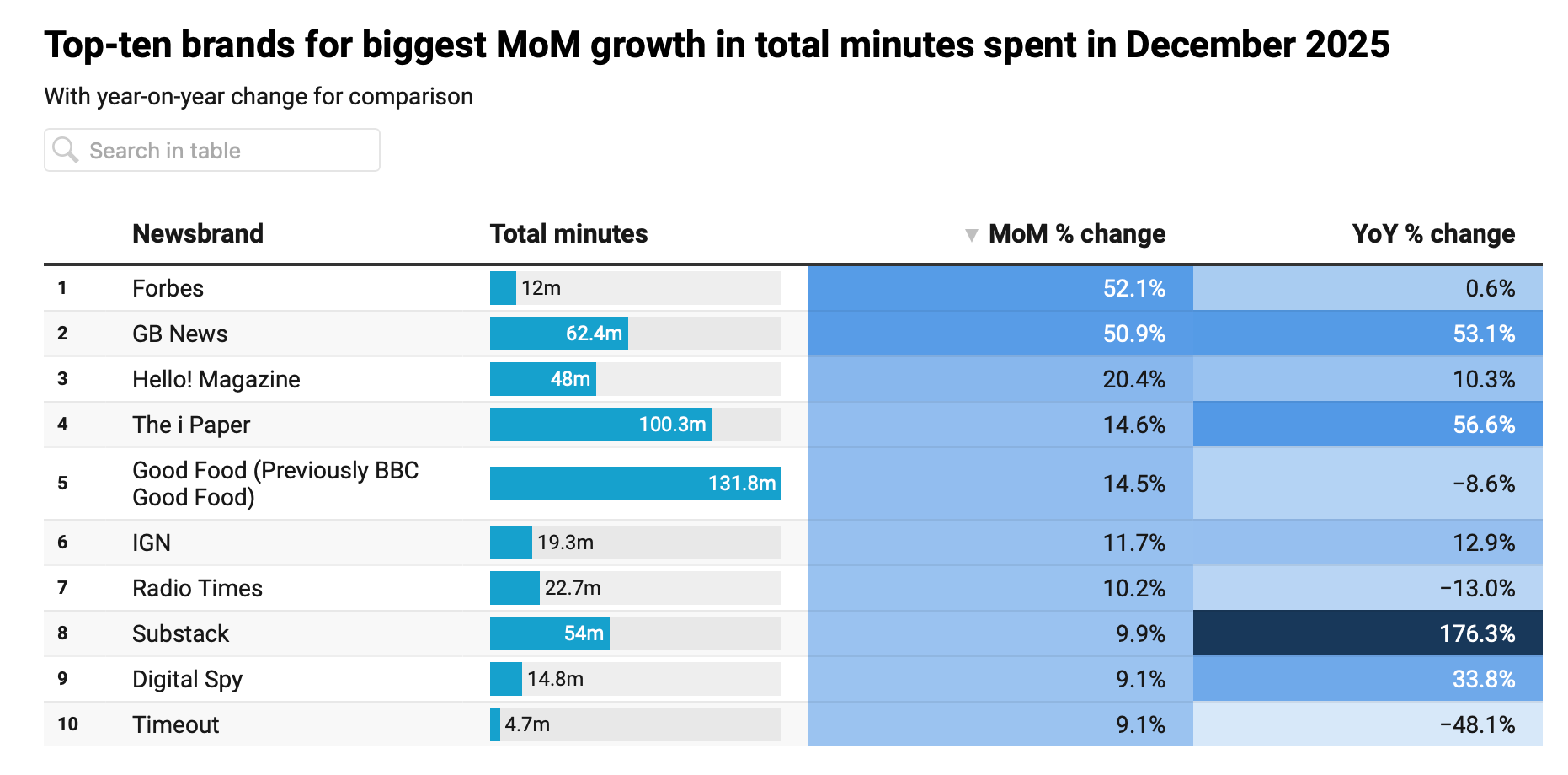
Back to GB News. I remember studying SEM Rush one day trying to figure out why GB News was becoming so popular in search - and I think it’s fair to say it’s due to a number of contributing factors in a post-Brexit Britain outside of people just punching queries into search. Still, the SEO play at GB News has been strong - widening its hard news coverage to target strategic topics it wants to own. The headlines and content are ripe for Discover as well, so it will be interesting to see how it adapts when the Core update rolls out across Blighty.
Kudos goes to Harry Clarkson-Bennett for his latest series looking at Information Retreval. Again, this probably sounds as dull as dishwater for the uninitiated but, fear not, Harry is fond of cracking the odd joke or two and his elucidation of the differences between training data and RAG for AI models is nothing short of ‘on fleek.’ Essential reading.
It seems that the word innovation is becoming synonymous with the Bauer Group and it was fascinating to hear from Stuart Forrest at Flashed and Flames in London about the various (AI) tools that have been rolled out to content teams to help workflows. I particularly liked the tool that helps identify which pages should be updated based on performance. Content management systems often struggle with this kind of intelligence, forcing writers to maintain spreadsheets where they have to copy and paste articles, then follow up a month later (if they remember). It’s all very arduous and frankly boring, so as someone who’s worked in Product developing in-house content management systems, I’m all up for this kind of wizardry.
(Psst: Speaking of CMS, I wrote a little piece for Glide this week about the dominance of AI Visibility in our content discussions: Opinion: All this talk of AI visibility is killing your news business)
I guess the recent Ahrefs report announcing that AI Overviews are reducing clicks by 58% was another kick in the teeth. This is why it’s crucial that teams are aware when an AI overview appears in the SERP and how they can adjust accordingly. This is also why it was important to hear from a selection of top UK audience growth specialists about the impact of AI in search. It turns out Zero Click doesn’t mean ‘no clicks at all’ and publishers shouldn’t be demoting SEO in their list of 2026 priorities. Over to the Mail’s Carly Steven:
”“Search isn’t dead. It is fragmenting; queries can start beyond a traditional search engine, and platforms increasingly influence each other. This demands different thinking on optimisation and more nuanced KPIs. Google’s systems are increasingly focused on rewarding genuine quality content… I think this has to be the main focus – create content that truly satisfies users, and the algorithms generally follow.”
And if you wanted to consider some metrics that might help you with that process, you could read this.
PS: if you liked the pomp and ceremony of this update you may also like to catch up with all things audience growth on the Beers & SEO with Barry and Steve podcast.
Related articles
Best TikTok Publishing Times, Al Jazeera, Google Discover, Sun Video & William Gibson
The Power of Google Discover for Publishers with Nicola Agius
How Global South World Is Taking on Brainrot, Algorithms and News Avoidance
Newsrewired 2026: In Opaque Times, Let Experimentation Shine Through
Young Audiences Haven’t Abandoned News. They’ve Abandoned the Old Ways of Finding It.