

Let’s leap in.
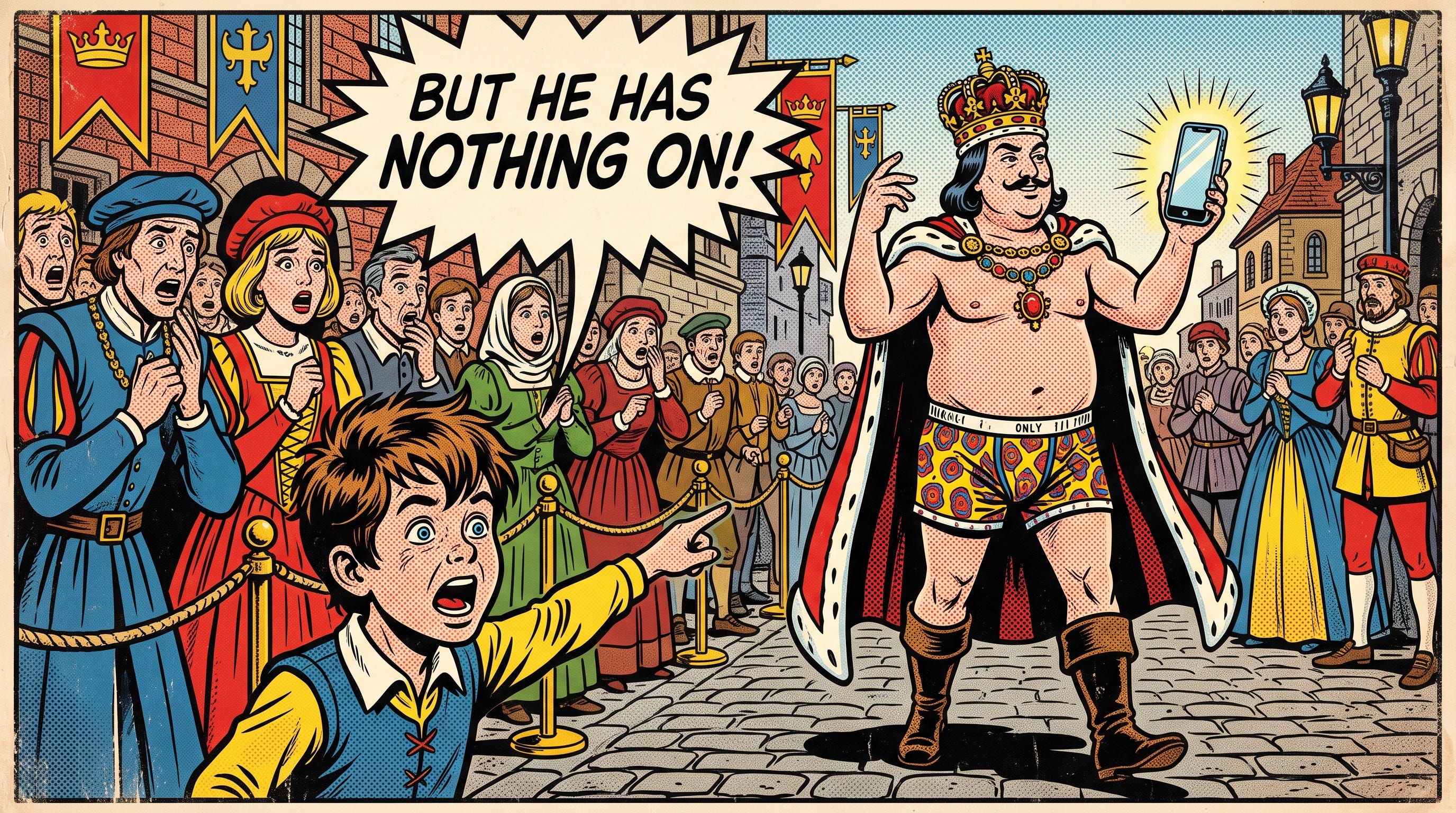
Is AI visibility a boondoggle? A sham? A distraction?
This week Rand Fishkin flagged three articles that questioned the actual value of GEO. The post is worth reading, not just for the articles like this great one by Marie Haynes but also for the comments. I think if you are equating the value of GEO with volume of clicks then that’s only going to lead to tears. Think of it more as a brand marketing channel and try to avoid short term GEO-specific tactics that might ultimately lead you to being penalised by Google.
PS. Thanks to that article by Marie, I am now using Antigravity.
3 ways to open a new door to news brands beyond paywalls
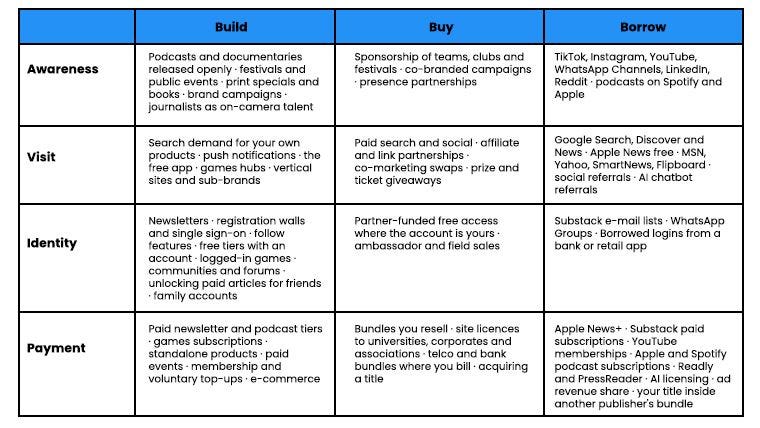
Greg Piechota at INMA offered a neat framework for reaching new readers. You can build a door yourself, buy access to someone else’s audience, or borrow another platform on its terms. Then you ask what each door hands you: awareness, a visit, an identity (an email address or phone number) or a payment. The case studies are strong including El País, HLN and Apple News+.
Why it matters: The lesson from INMA’s case studies is to pair every way in with a way to capture the reader, so no visit leaves without you asking for something.
Thanks to Sarah Marshall for surfacing this.
The next newsroom is an action centre
A great presentation by Dmitry Shishkin on why newsrooms should be really focused on utility and how they can improve their audiences’ lives. This is exactly what we’re seeing today with brands like Zetland and I’m all for it! I particularly liked his line ‘A topic without a service is just coverage’ - that’s brilliantly concrete and not something I hear a lot of in newsrooms.
Will the Open Web Survive AI?
Shout out to Andrew Webb from Connectopia who has some excellent thoughts about the future of the web, in discussion with host Choy Travers. Well worth watching, perhaps we need to think less about destinations and more about agentic.
Poisonous Google SERPs
ICYMI: A BIG story from last week with research from Nozzle showing that, since last month, Google has been serving rank trackers ‘poisoned’ results pages. They look completely normal, with no error and no captcha, but most of the usual sites have been swapped out. Of 27.5 million SERPs analysed, 8% came back poisoned.
Why it matters: If your rank tracker showed a sudden one-day drop in late September, this is the likely cause. Check Search Console before you rewrite a single page.
Finding High-Value Converting Queries That Mainstream Tools Miss
Dan Petrovic’s point is that queries showing zero volume in keyword tools can still bring in real traffic, and competitors who rely on those tools won’t see you coming. His example is the title of an academic paper, which his keyword dashboard said nobody searched for. Search Console disagreed: 1,020 impressions and 37 clicks in a June spike at an average position of 4.3, and that’s before counting all the variations.
Why it matters: Publishers sit on one of the best sources of this data and mostly ignore it. Internal site search tells you what readers want, in their own words, long before any keyword tool catches up.
Google Search Issuing More Google Manual Action Penalties?
Barry Schwartz picks up a trend that feels very 2012. Marie Haynes says requests for help with manual actions have gone from essentially none to several a week, mostly for thin content, pure spam and scaled content, and mostly from legitimate, long-standing businesses. Daniel Foley Carter is seeing the same, and blames businesses that cut their SEO spend because AI could supposedly do the job.
Why it matters: If you’ve scaled content with AI, check the Manual actions report in Search Console now, not after the traffic has gone.
Sarah McDowell: Here are my slides from my brightonSEO talk
Sarah’s BrightonSEO deck, The SEO Case for Podcasting: Your Perfect E-E-A-T Strategy, takes each letter of E-E-A-T in turn and shows how a podcast feeds it.
Why it matters: A podcast puts real, named people with real expertise in front of your audience, which is exactly what Google says it wants to see.
How I got AI to trust a medical device company in one month
Joeri Vanhamel’s client, a medical device company, had excellent doctor-written articles that AI models never cited. The reason: nothing on the site let a machine check who the doctors were or what qualified them. He completed the author bios, joined up fragmented author profiles and built an EntityMap. Over a month, Waikay’s score for Gemini’s answers without search rose from 27 to 83 out of 100, while the score with search stayed roughly level. Joeri is careful to say this shows correlation, not proof.
Why it matters: Credentials only count if a machine can verify them. For publishers covering health, money or law, that means complete author pages that link to the registers and regulators that back up the claims.
Claude Got Guidelines, Now What?
On 8 October, Anthropic updated its usage policy, and Mike King spotted the bit that matters for search. Claude can no longer be used to manipulate the sources AI systems draw answers from, for example with a network of sites posing as independent sources that all back the same claims. The change takes effect on 12 November. Mike reckons it’s the first time a frontier AI company has written ‘don’t game AI answers’ into its rules in plain language. He then walks through 20-odd years of Google writing the rules first and enforcing them later, from the Florida update in 2003 to the 2024 spam policies. Really useful.
Why it matters: The policy covers what you can do with Claude, not how Claude ranks or cites your content. But if your content or outreach runs on Claude, these rules now apply to your workflow. And as Mike shows, the rule usually arrives before the penalty.
InPublishing: September/October 2026
The latest InPublishing is out, and it’s free to read once you’ve registered. The centrepiece is a 12-part ‘AI in practice’ series, with contributors from Hearst UK, Immediate Media, IOP Publishing and others explaining how they use AI across editorial, images, product and monetisation. Also worth your time: Sajeeda Merali on why publishers need an AI strategy before they sign an AI licence, and Meg Carter on podcasts’ missing link, the written word.
Until next time,
Steve