

As we all know, trust continues to be a key pillar of any editorial proposition, but although many publishers will reference this at conferences and in 2026 prediction articles, I still can’t get past this Catch 22:
Publishers want to be able to talk about editorial standards, their values, mission statements etc but…
..it’s no point talking about these if audiences aren’t engaging with you across social, search or AI etc
…and often that can’t be achieved unless the publisher ‘plays to the algorithm,’ often producing low-value content for the clicks…which defeats point 1.
In the past, ‘playing to the algorithm’ has often been justified by suggesting that low-value content pays the bills, and allows the journalists the opportunity to focus on quality coverage e.g. local stories, opinion pieces and investigations.
But, in actuality, what has happened is that, as the value of ad display continues to decrease, the low-value content no longer ‘pays the bills’ and journalists are stuck having to produce even MORE low value content like a hamster on a wheel.
I can’t blame any publisher for doing this, I’ve been there myself launching new digital products and looking at the analytics every minute/hour in search of spikes. In many ways it’s what you HAVE to do to understand what your audience really wants.
For instance, when we launched PopBuzz we thought were creating a music-orientated product but soon discovered that what the audience really wanted was a pop culture product focused on issues and lifestyle. We certainly wouldn’t have discovered any of that if we hadn’t worked with the algorithm to figure out what chimed with the audience.
But there is always the danger that, at some point along the way, we get more addicted to the spikes rather than trying to forge a deeper connection with the audience.
And now, we are in an even more challenging environment, one where human-created content on the interweb is on the decrease, one where you can stumble across questions like this on Reddit:

How can a publisher possibly compete with AI slop like this? Especially as platforms like Google find it increasingly hard to identify what it thinks is a legitimate news website?
Well, I think publishers can try quite a few tactics which I’ll call The Peep Show Method.
(Non-UK readers stay with me. Peep Show is a 90s comedy featuring a dysfunctional friendship between two guys, one serious (Mark), the other (Jeremy) the complete opposite. Basically, Id and Super ego - dig?)

I might be stretching the point here but by following the character traits of these two characters, publishers can take a two-pronged approach to building trust with audiences.
Let’s take the serious (Mark) side. Publishers can:
Reach team agreement on a mission statement that displays the values that are most important to the org and that show you have the audience’s back. Publish said statement on a corporate website.
Film transparency - think prepared, well lit and somewhat scripted newsroom conversations or like that last five minutes you get with the camera team at the end of every big BBC David Attenborough show.
Consistent coverage - sometimes letting people know you have their back is just by being there at every breaking news moment.
Likewise, newsletters and notifications pinged in the knowledge of what the audience wants and when it wants it.
Demonstrate understanding of an audience via well timed and targeted articles e.g. Best Family Ski Resorts that’s published in September for your relevant (and affluent) audience.
Everything we are taught as journalists about shining a light and holding power to account.
Admitting mistakes.
More video content featuring presenters and journalists
Formal-ish tone
On the other hand, a more playful (Jeremy) side might focus on:
Showing transparency is a less formal way - news can often be creative, chaotic spaces so reveal more of that. Photos of the team at work taken with the mobile phone rather than a professional camera (I’m thinking Uusi Juttu here).
Question if you really need that super-produced studio for your podcasts. Think less polished, more ‘punk.’ (Although, NEVER poor audio of course. There’s never an excuse for a bad mic).
More ‘Wow’ moments that delight. These could be:
Gamification/UX of the news consumption process. Unlocking achievements or occasional Easter Eggs.
Who is interviewed, what is investigated. Not only do you want audiences to go ‘Wow, I never knew that!’ you want them to go ‘Wow, I never knew The Times/Guardian/Mirror did that!’
Quizzes that offer a comical take on the news - anyone remember Martin Belam’s UsVsTh3m and their games?
Newsletters with personality. Yes, you can have your Editor’s Forward, but can it crack a good joke?
Data Visuals which are both informative and playful e.g. Vox, Tortoise, Guardian Crunch.
Interactivity, encouraging audiences to play with your data.
More (vertical) video content featuring anyone from the team who is comfortable on camera.
MORE WIT LESS WORDS. Short, distinct and snappy - help audiences feel they are in on the joke even if that joke is about latest index funds and dividend stocks.
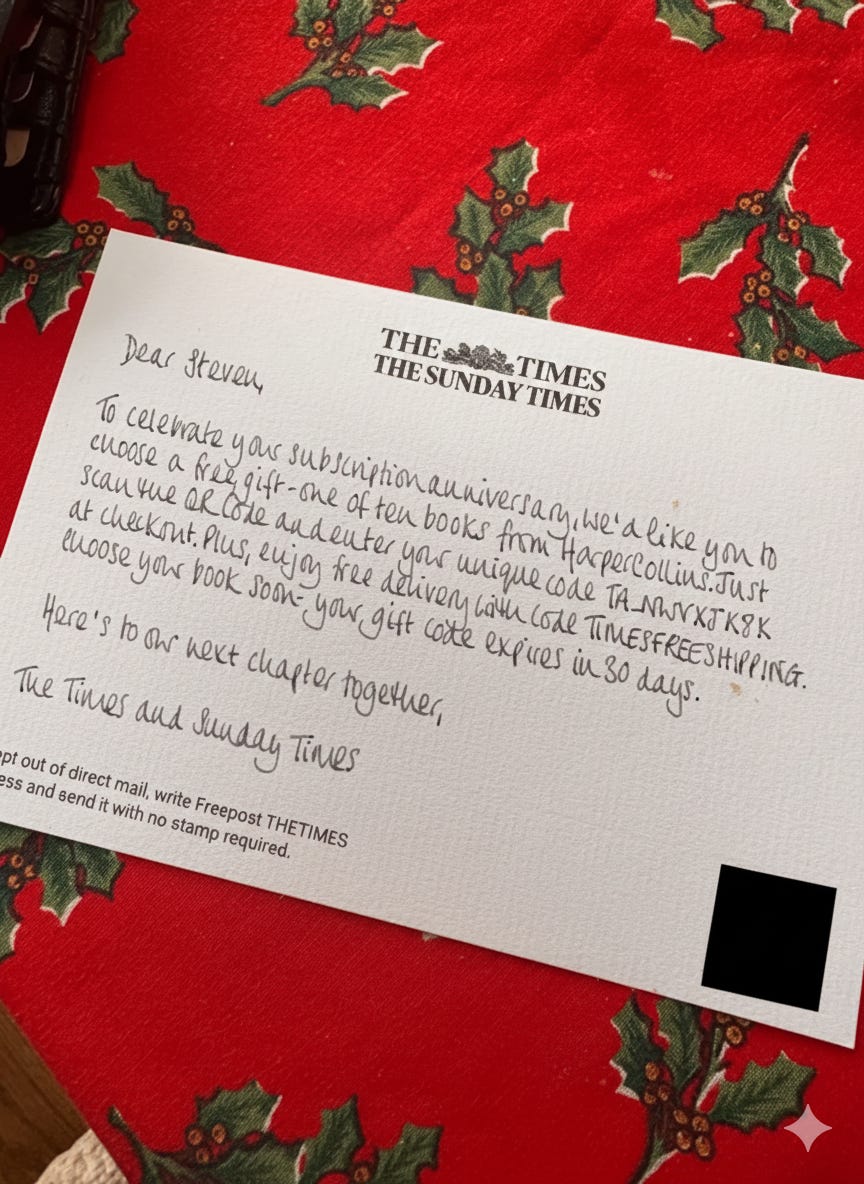
Personalised moments - surely we can do better than the birthday email from brands we thought we’d unsubscribed from years ago? Maybe something like this which I received from The Times in December offering me a free book as a thank you for my subscription loyalty (don’t worry, I’ve used the code).
There are many more examples I could include but the point is publishers need to be BOTH Mark and Jeremy. Building trust is not just about posting a mission statement (although that is important) - it should permeate every action that the publisher takes AND, where possible, underline the value of journalism to the audience in MULTIPLE TONES.
That second bit is a bit more tricky - because you never want to be like Peep Show’s Mark breathing down your neck about the importance of journalism as you tuck into your news article (BUT you’d be surprised how many publishers DO NOT make it easy to find out more about how the editorial sausage is made and why it is important.)
Sometimes you can demonstrate value simply by demonstrating that you care.
This is why I think more publishers will team up on more collaborated investigations in 2026 - think Europe Uncovered 2025 which partnered The Guardian, Paper Trail Media, Der Spiegel, ZDF, Der Standard and De Tijd. Projects like these work not only because of the collaborative firepower - they also demonstrate the value of journalism implicitly through the insights they generate.
Lastly, I’d like to see more examples where we can see the editorial coverage challenged by those that disagree with it. This is why Community Managers will become more important so we can hear from a variety of voices and understand their objections.
As I keep telling my bored teenagers, in life, as with political discussion, it’s critical that we meet others that can challenge our opinions - it’s how we grow and develop as humans. Surely, with AI reinforcing the bubbles we all want to conveniently live in, publishers have a real opportunity here to shake us up?
Which is why we need to be more positive about AI in general, to help newsrooms focus on the stories that really matter, fuel their delivery and help cut through the AI generated noise out there. I think Newsquest are doing some interesting things in this space with AI reporters.
We stand at a pivotal moment - we can either be buried by AI OR enable it to help us educate audiences about what we do, why we do it, and how it adds value to their lives.
And on that front, I am entirely optimistic - unlike Peep Show which was always tinged with, like all great UK comedy, a healthy dose of existential despair.