

‘We’re F@cked’
That was the response from one audience expert I spoke to this week after they read the latest Reuters Digital News Report.
But is it all doom and gloom?
Well, let’s take a closer look…
The report is always significant because it shapes how the news publishing industry talks about itself over the next 12 months.
But as a self-confessed cynic, I’m usually a little bit ‘meh’ when the report drops because it often reaffirms what we already know has been happening for years: direct traffic is declining, people are becoming more partisan, and there are now more ‘news avoiders’ than ever before.
I mean, there really was a distinct lack of gags in this year’s edition. I should know, I read all 178 pages and all I found were themes like this:
1. The Decline of Direct Access
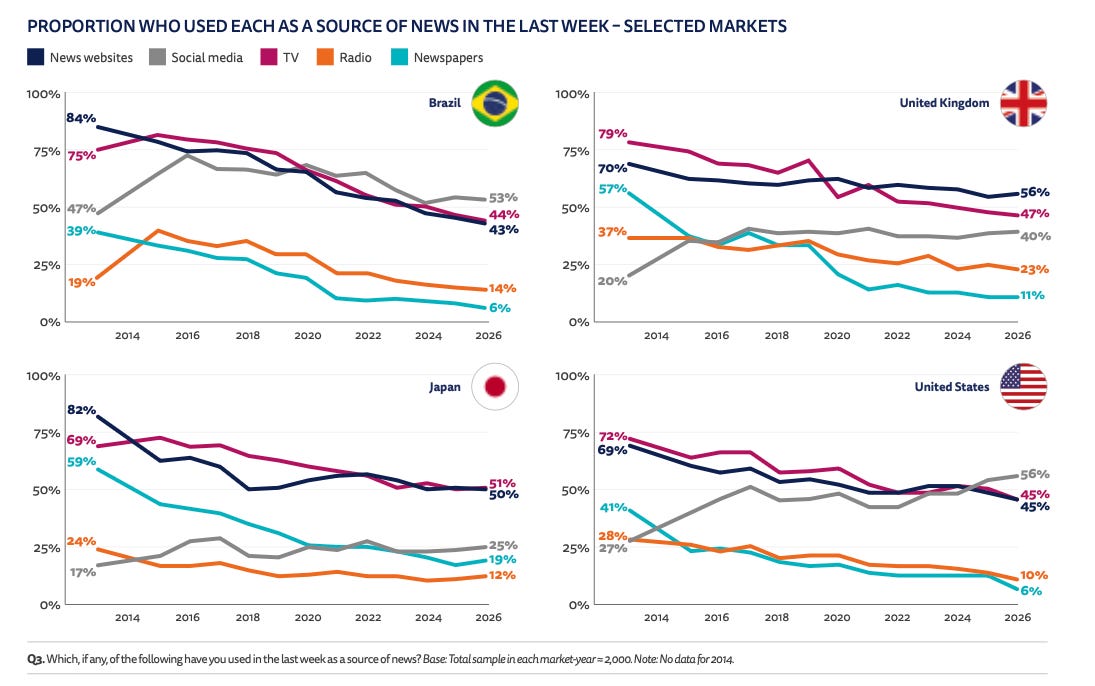
Social media and video networks have now overtaken news brand websites and apps as the most widely used way to access news globally.
This is a major milestone in the “platformisation” of news, where the pathways between journalism and the public are becoming less direct, more fragmented and less intentional.
In other words, news organisations are losing control over the gateway to their own content. They are being forced to compete on third-party platforms where their branding is often diluted, their relationship with audiences is weaker, and their ability to build habit is much harder.
2. The Traffic Referral Crisis Continues
Publishers are also facing a “precipitous fall” in referral traffic from search engines, increasingly described as ‘Google Zero’.
That means:
Massive traffic drops: Organic search traffic to news sites is falling sharply, especially in major markets.
Future fear: Publishers expect search traffic to fall further as AI-generated overviews and answer engines satisfy user needs without requiring a click-through to the original source.
Google Discover fragility: Some major publishers have already reported significant drops in Google Discover traffic as platforms prioritise user-generated content and video over news links.
Note: We do need to be cautious when discussing Google Zero, or Zero Click. There are many ways publishers can still attract audience through this channel - but they do need to work harder to achieve results.
3. Trust and Interest Hit Record Lows (well, almost)
The report also highlights a darkening public mood around news itself.
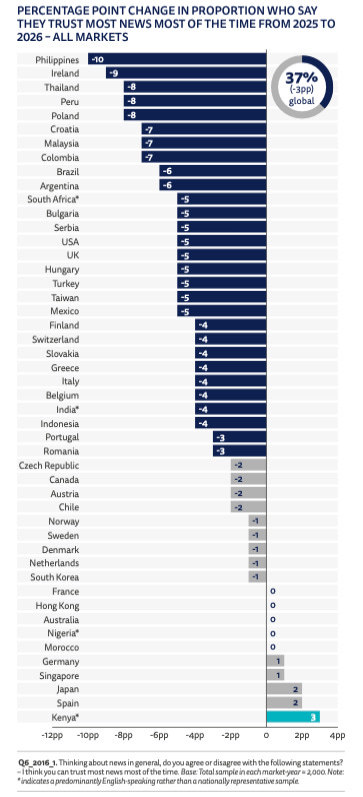
Trust collapse: Global trust in news has fallen to its lowest recorded level since measurement began.
Waning interest: Since 2021, the proportion of people who say they are “extremely” or “very” interested in news has dropped significantly.
News avoidance: More people globally now say they sometimes or often actively avoid the news.
4. Stagnant Reader Revenue
Reader revenue also appears to be plateauing.
Stagnant pay basket: The percentage of people paying for online news remains stuck across many tracked countries.
Shrinking funnel: Because reach on owned news sites is declining, the top of the subscription funnel is shrinking too, making it much harder to acquire new paying users.
Uncertain value: In some major markets, payment for news has actually fallen.
5. The Rise of “AI Slop” and Fake News Concerns
Publishers are operating in an environment where concern about fake news remains high.
The proliferation of AI slop and deepfakes is escalating those anxieties. And yet the report also points to a paradox: audiences continue to use less trusted platforms because they are more convenient.
That means publishers are increasingly being forced to compete for attention in environments that are liked, but less trusted — and where the risk of misinformation is often highest.
So, you can kinda understand when someone says:
“We’re F@cked.”
But, I actually found there were quite a few positives in the report, particularly when it came to young audiences (specifically those under 35.)
Because the data does not suggest younger audiences have given up on news.It suggests they care more about format, ease of delivery, relevance and accessibility than any specific brand name.
Here’s why:

Platform-First Discovery
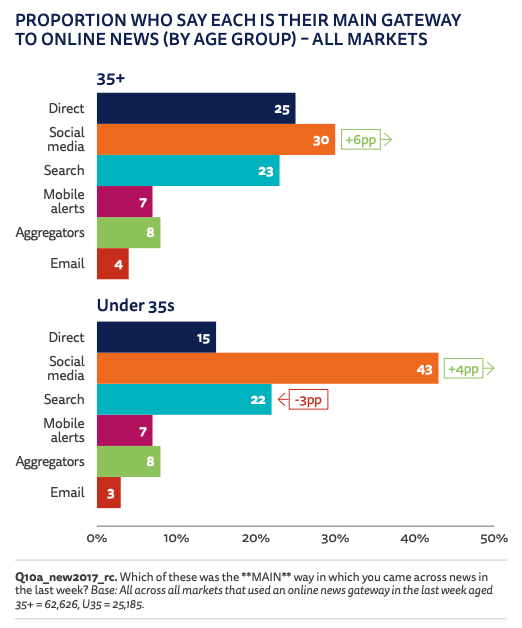
For 18–24s globally, social media, video networks and AI chatbots are now central ways they get news.
This is a very different behaviour from older audiences, who are more likely to have fixed habits around visiting specific websites, apps or broadcasters.
For younger audiences, the starting point is often the platform, not the publisher.
Incidental Consumption
Younger users are also less likely to have fixed news routines.
Their news consumption is often “incidental”, meaning they encounter news while on platforms for other reasons rather than intentionally seeking out a specific brand.
That matters.
Because it suggests the issue is not that young audiences do not care about news. It is that news often reaches them in different contexts, formats and moments than it does for older audiences.
Traditional vs Creator Trust
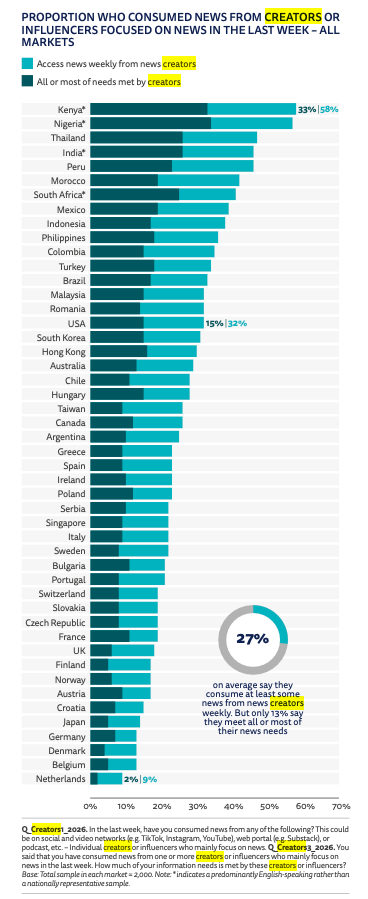
Generally, younger audiences find individual news creators and influencers more relatable and easier to understand than traditional news media.
However, on a global average, they still perceive established brands as more knowledgeable and impartial.
This is critical.
Young audiences may not always start with the institution, but that does not mean institutions have no value. It means the way that value is communicated is changing.
The “User” Exception
While the general population tends to trust creators less, young people who actually consume content from creators often view them as more trustworthy, authentic and knowledgeable than traditional outlets.
In some markets, 18–24s view creators as more trustworthy than mainstream media — a much starker contrast than we see in the wider population.
That should not be dismissed as young people being naive.
It should be understood as a signal that tone, format, relatability and perceived authenticity now play a much bigger role in how trust is built.
Institutional Fragility
Overall trust in news has fallen to its lowest recorded level, but trust in widely used individual news brands is holding up better than trust in “the news” as a general concept.
That distinction matters.
People may be sceptical about “the media” in the abstract, while still trusting specific brands, journalists, creators or formats they use regularly.
Enduring Support for Impartiality
Despite their preference for social platforms, younger audiences still largely support the ideal of impartial news.
Yes, 18–24s are slightly more likely than older groups to prefer news that shares their point of view. But a clear plurality still wants news that does not take a side.
Looking across social differences, young people and people with low levels of formal education are both groups that are less likely to say they prefer getting news from sources that don’t have a particular point of view. A slightly larger share of 18–24-year-old respondents say they prefer news from sources that share their point of view, or from sources that challenge their point of view.A significantly larger share of those with low levels of formal education answer ‘don’t know’. In both groups, however, a clear plurality still expresses a preference for impartiality. (Page 58)
So, in summary, younger audiences do care about information provenance.
Many are using AI chatbots specifically to verify news, understand context or find out more about a source. But they are also increasingly likely to trust personality-led, accessible formats over traditional institutional voices.
So, young audiences are still consuming news. They just don’t always get it from a homepage, an app or a brand they already know.
So the challenge is not to force them back to old habits. It is to make news work better in the places they already are.
That means clearer formats, better explainers, more human voices, and stronger signals about where information has come from.
There you go. A simple ray of light in an otherwise quite challenging report.
Related articles