

Each year, I always look forward to this annual report by Nic Newman because it tells us so much about where the (news) publishing industry is heading. Observations are compiled from a healthy number of survey respondents and advisors (myself included), so it’s a pretty comprehensive assessment.
I’d encourage anyone in the news industry to read the report directly but here’s what the report tells us about newsroom content strategies for 2026.
1. Double down on content AI can’t easily replace
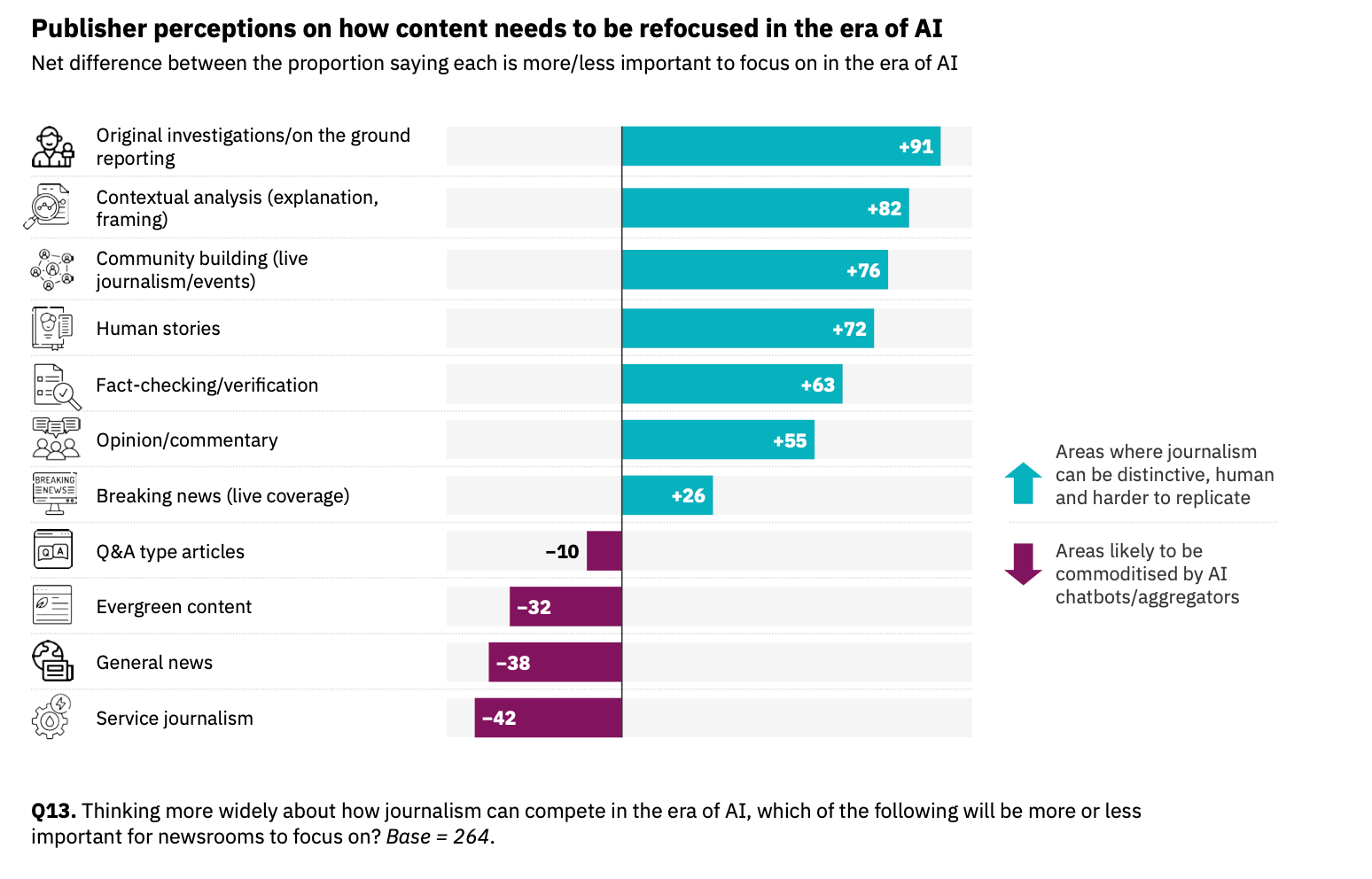
It may not be surprising that a major theme in the report is that publishers are really trying to focus on distinctive, human, and relationship-driven journalism, while moving away from content that AI and platforms can easily commoditise
Publishers themselves are clear that survival depends on distinctiveness, even at the cost of some reach. The strongest areas of strategic focus are:
Original investigations and on-the-ground reporting
Contextual analysis, explanation, and framing
Human stories and narrative journalism
Fact-checking and verification
Opinion and commentary with a clear voice
These formats are harder for AI answer engines to summarise into bullet points and are more likely to build trust and loyalty. I’ve written further on how publishers can navigate zero click here.
2. Deprioritise commoditised formats
Executives expect significant decline in value for content that AI chatbots and aggregators can generate or summarise more efficiently than publishers:
Service journalism (how-tos, tips, utility content)
Evergreen content (travel guides, TV listings, product reviews)
General, undifferentiated news coverage
Much of this content is already being absorbed into AI search overviews, reducing referral traffic.
3. Shift from “articles” to multi-format, liquid content
The report shows a clear pivot beyond text:
Video is the top investment priority (especially short-form and vertical video).
Audio (podcasts and new formats) is also a major growth area.
Text remains important, but no longer the default growth engine.
Publishers are encouraged to design stories as “liquid content”—modular, adaptable, and easy to repackage across platforms, feeds, and AI interfaces.
4. Put a human face on journalism
The rise of creators is forcing publishers to rethink tone and presentation:
Journalists are being encouraged to behave more like creators
More emphasis on personality, voice, authenticity, and behind-the-scenes storytelling
Greater visibility for individual journalists across video, social, newsletters, and events
This reflects a broader shift from institutional authority to relationship-based trust. I would also add that the report did highlight that some publishers were anxious about losing some of their top talent to the creator economy. I don’t think I’ve read that in previous reports.
5. Build community, not just traffic
With search and social referrals declining sharply, content strategy is increasingly tied to habit and loyalty, not clicks:
Live journalism and events
Newsletters and podcasts
Community spaces and direct audience relationships
The goal is repeat engagement rather than one-off visits from platforms.
6. Design for AI discovery, but don’t abandon SEO efforts
Publishers expect continued traffic losses from traditional search and are beginning to adapt content for:
AI chatbots and answer engines
Citation, attribution, and visibility inside AI interfaces (AEO/GEO)
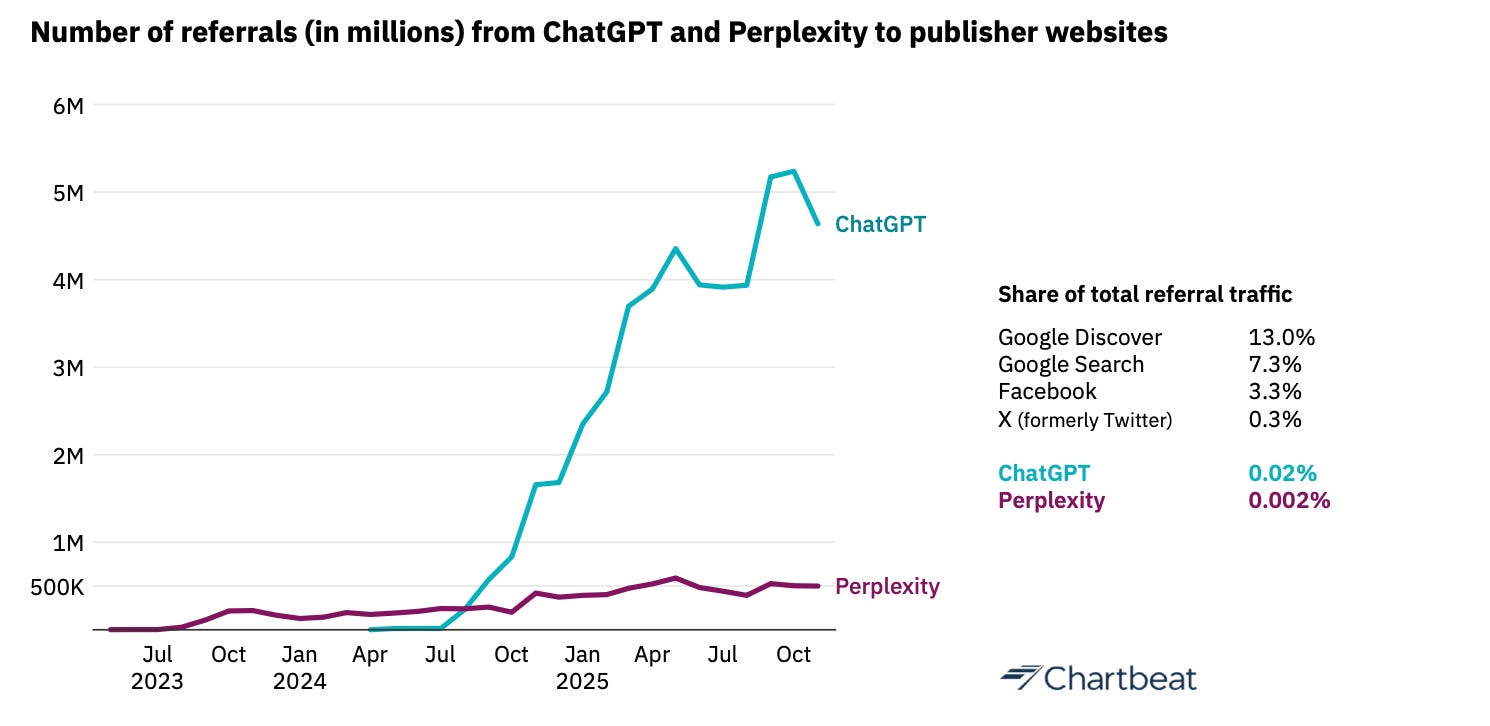
This doesn’t mean producing more generic content—but structuring high-value journalism so it remains discoverable and attributable in AI environments. I was particularly pleased that the report highlighted the point that Google continues to be a major driver of traffic to publishers, vastly more so than AI answer engine referrals.
I’ve written previously about how newsrooms can optimise for AEO/GEO - although I should admit that this area is moving so fast I might have update this list very soon.
To round off
It’s very apparent from this report that publishers are responding the declines in traffic from both search and social and the advent of AI by focusing more on originality, humanity, format diversity, and direct audience relationships. The winning strategies are not about out-producing AI, but about being unmistakably human and meaningfully distinctive.
Related articles