

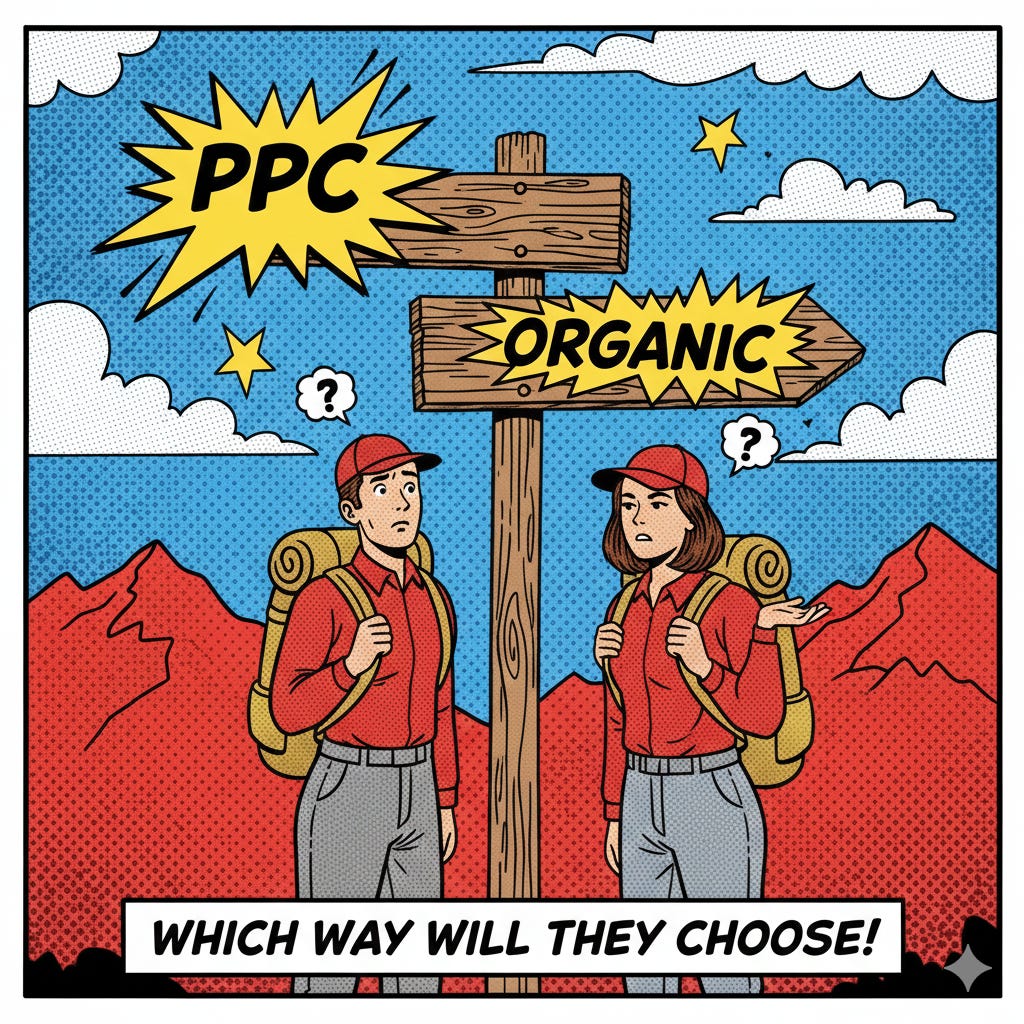
Right now, many publishers are asking a critical question: “Should we pivot more of our budget into PPC given how search results are changing?”
And it’s a reasonable question. Search engine results pages are increasingly crowded with paid, sponsored, and AI-generated features, sometimes pushing traditional organic listings further down the screen. Industry discussions on LinkedIn and at conferences are ablaze with the news that search behaviour is in flux and the rules of discovery are being rewritten.
But before you decide to reallocate 80–100% of your marketing budget into paid search, let’s look at why organic search — and the strategic optimisation that underpins it — still offers the strongest return for most publishers.
The Shifting Search Landscape
Over the last year, Google and others have continued to increase the presence of paid and sponsored positions in search results. These include more paid headlines above the traditional blue links and AI-driven answer boxes replacing or reducing organic clicks.
The implication for publishers is that visibility above the fold is getting more competitive BUT this shift doesn’t mean organic is dead — it means organic has evolved.
(For a wonderfully well-written appraisal of everything that 2025 threw at us in search, you can read Lily Ray’s article here.)
Organic Search Still Delivers the Majority of Clicks and Value
The most recent traffic studies consistently show that organic search still drives the majority of clicks on most queries, even with more sponsored content in SERPs.
Despite the encroachment of paid and AI features organic search still accounts for 90% of all traffic from search, PPC only 10%
In addition, users continue to trust and click on organic listings more often than ads when relevance and rankings are strong.
For publishers that’s a powerful argument for keeping SEO at the centre of your growth strategy.
Why Organic Is a Better Long-Term Investment for Most Publishers
1. Organic Benefits Compound Over Time
SEO isn’t a sprint — it’s an investment in evergreen visibility. A well-ranked article continues to attract searchers long after it’s published. PPC, by contrast, delivers immediate visibility that stops as soon as spend stops. It still surprises me that, although the compound nature of SEO has been widely known for years, it’s still relatively unknown in some digital teams. If that’s the case in your organisation, then Eli Schwartz has a great explainer here.
2. Organic Builds Authority and Trust
Readers regard organic results as more credible than ads. That’s particularly important for news publishers where trust and quality are fundamental brand values under constant scrutiny. Investing in SEO strengthens your domain authority and signals expertise to both users and algorithms.
3. Organic Is Cost-Efficient in the Long Run
Yes, PPC can deliver short bursts of traffic, but at increasing CPCs — especially for competitive or newsworthy topics. Organic optimisation, once in place, doesn’t incur a per-click cost and scales more economically as you grow.
When PPC Should Still Play a Role
In no way do I mean to suggest that PPC doesn’t have a valid role in your publishing digital strategy. Strategic deployment of paid search can be highly effective when:
You want immediate data when launching new products or content verticals — PPC can help you get early visibility while organic traction builds.
Testing headlines and topic angles — PPC data often reveals what resonates before you invest in full editorial.
Supporting Brand Partnerships and Advertiser Campaigns - When publishers run branded content or sponsored features for advertisers, PPC can enhance campaign performance by driving guaranteed traffic volumes, supporting multi-channel visibility, helping an advertiser hit impression or session targets. For many commercial teams, PPC is a value-add upsell that strengthens advertiser relationships.
Greater Control Over Targeting - Organic search depends on how algorithms interpret your content. Paid search gives you control over keyword targeting, audiences, devices, scheduling, budgets, ad copy and landing pages This level of control is particularly valuable when launching experimental content or testing new revenue models.
Supporting publisher subscription strategies— through PPC, publishers can learn how to best position their subscription pages by testing the language used and the actual value proposition. As we’ve said before on the Beers & SEO with Barry and Steve Podcast, you’ve be surprised at how many publishers DON’T use techniques like this to listen to their audience and adjust their marketing accordingly.
In all these situations, PPC can act as a very powerful feedback tool and tactical amplifier.
How to Balance Your Investment in 2026
For most publishers in the UK and beyond, a strong allocation model today might look like this:
70–90% investment in organic SEO: Technical optimisation, content strategy, editorial training, user intent mapping, structured data audit etc.
10–30% in PPC and paid search: Strategic campaigns tied to launches, specific commercial goals, or testing.
Of course, every business is different - for instance in some industries like travel or automobile it might still be necessary to bid for top PPC placements even if you have already secured the top organic spot. Another example might be podcasts where, although Spotify and Apple dominate organic, you may still want to drive listeners to your own platform to listen to the podcast where you can then upsell the benefits of subscription.
(Although that kind of approach would completely depend on the actual cost of the campaign!)
But a typical balance like this would mean that you’re building long-term discovery while still having the agility to test and experiment where it matters most.
The Bottom Line
Yes, the SERPs are changing — more sponsored positions, more AI features, and more complexity. But organic search remains the backbone of sustainable visibility and audience growth for publishers. Paid search has its role, especially as a tactical tool, but investing heavily in PPC at the expense of SEO is rarely the most efficient path for publishers.
In an era of zero-click, publishers who combine strong SEO fundamentals with smart PPC tactics will outperform those chasing shortcuts.
Until next time.
And..If you’d like a tailored analysis of how this applies to your brand — from topical authority to technical SEO opportunities — I’d be glad to help you map out a strategy that aligns with both your editorial mission and commercial goals.
Related articles