

Firstly, excuse my lack of comms recently. I’ve been knee-deep in Claude Code, which has led me down a real rabbit hole, but has also helped me define a new hybrid approach to generating AI-assisted insights. I’ll write about that very soon.
What I am writing about today is a really productive series of talks at Media Voices’ first-ever publishing summit, hosted by Esther Kezia Thorpe and Peter Houston. The event took place at The Huckster in Paddington and covered a wide variety of topics, namely publisher growth strategies in a difficult market.
Kicking things off was Liz Settle, Managing Director of Good Housekeeping, who introduced a number of significant changes when she joined 2023 - although she refused to go so far as changing the actual name of the brand. As Liz said: “All marketers know that you mess with brand at your peril.”
Liz commissioned an audience research (‘Gentelligence’) report that recognised the strength of their “intergenerational voices”, with a demographic that ranged from 20 years to 90 years. Faced with economic pressures, some publishers might typically focus on only a specific segment of their audience, but the report highlighted that, although the age range of its readers differed, they had more in common than not.
“The world is designed to keep people apart, but it’s our goal to bring them together.” I really liked that phrase.
I hadn’t heard of The Good Housekeeping Institute before, but it’s the backbone of their product reviews engine. I really liked the way they message the legacy of this team and the value it brings to the audience. If ever you needed an example of EEAT in action, this is it.
One of the advantages of being part of the Hearst family is that Liz and her team can take successful case studies from other brands in the portfolio and adapt accordingly. They recently ran a partnership with retailers over a weekend where GH subscribers could get various discounts online — something inspired by regular Elle shopping weekends across stores in the Netherlands, where customers get 20% off clothes at select stores.
For Liz, Good Housekeeping can’t win at the “media game” because there’s just so much competition out there, but it can win on client direct, tapping into “small slices of the big budgets”. She says: “Advertisers are sick of performance; they want to build something exciting, and publishers are perfectly positioned for this.” Advertisers want “tangible relationships” with readers, and GH can offer this not only through the physical product - the magazine - but through events as well.
She noted: “Trust in magazines is rising at the same point it’s dropping off a cliff for social. AI is driving people to our brands, not away.” I think a lot of newsrooms can learn from case studies like Good Housekeeping, so it was a great first discussion at the event.
Elsewhere, Liz Wynn, Chief Supporter Revenue Officer at The Guardian, had some excellent points about her role in driving conversions. Even though many people subscribe to The Guardian to support journalism, she says “emotional connection is not enough”. Direct connections need to be forged through daily habits and an effective CRM process.
Her team is particularly laser-focused on moving free subscribers into their full digital paid offering. This is when the “last mile” of the customer journey becomes critical, so it’s important to get packaging and messaging absolutely singing.
To help with this, they have introduced a “Supporter Editor” who acts as a bridge between editorial and the supporter team.
Liz noted that, rather than being a business that spreads its bets widely, they are really driven by the theory of marginal gains, really focusing on making small incremental changes across their touch points - although I did note they also have to fight for dev resource just like the rest of us!
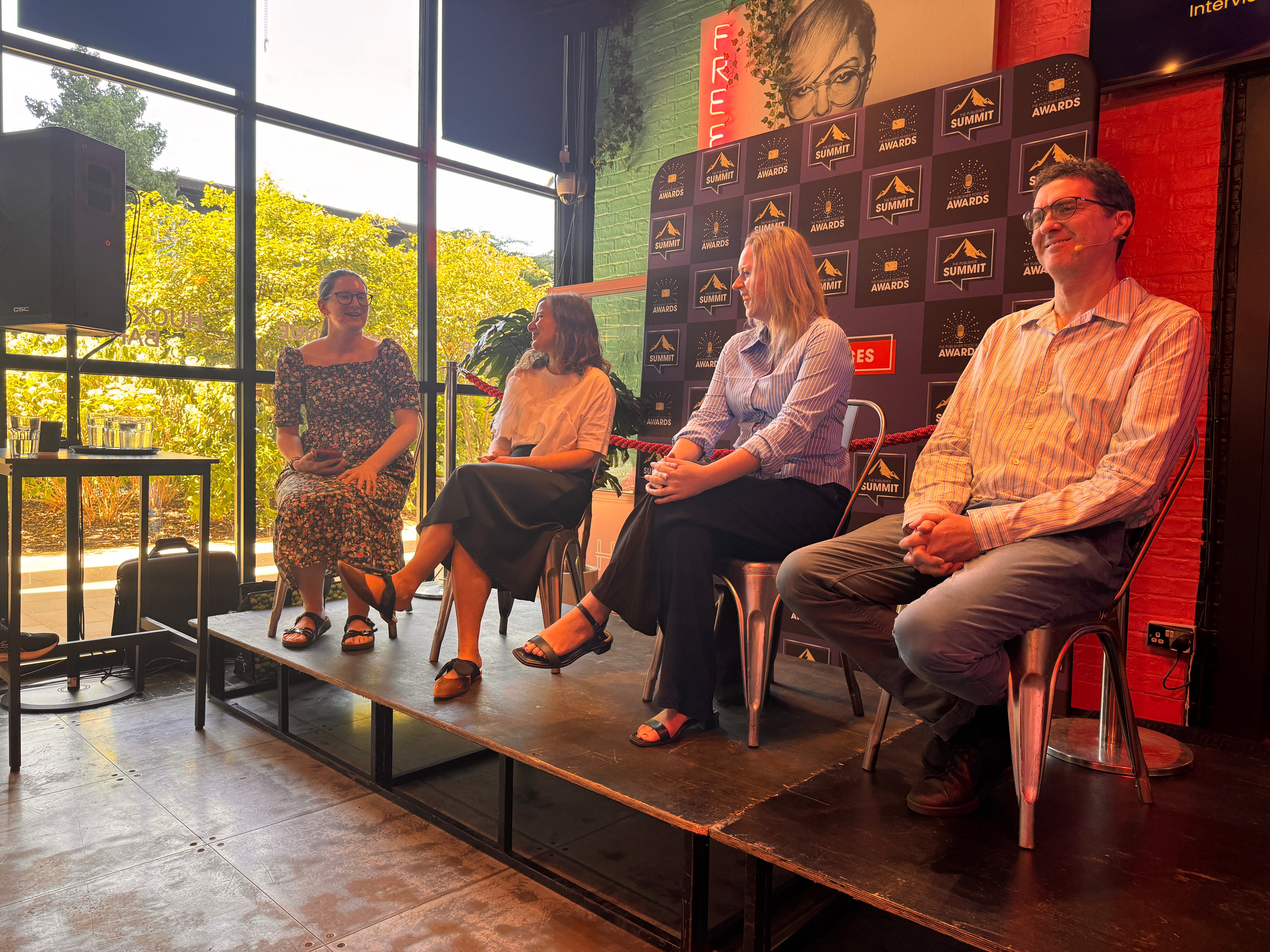
Elsewhere, it was interesting to hear more about the “less is more” approach The Times and The Sunday Times are taking, courtesy of Deputy Head of Digital Anna Sbuttoni. This has already been covered in greater detail elsewhere, but this was a great session to find out a bit more about their drive to grow audience interest by producing less.
All good content audits have to start by establishing some kind of performance threshold, and for The Times, they looked at how many articles they were producing daily that delivered fewer than 2,000 subscriber reads. It turns out it was nearly a quarter of their overall output.
I thought it was interesting that the stories that hit the “red zone” weren’t just commodity news stories that you could read anywhere online. Stories may have underperformed due to poor headlines, overall presentation, or simply because they were published late. So topic choice itself might not be the issue.
This led to cutting 20% of their daily output down to approximately 160 articles in favour of articles that deliver more value. But what defines value exactly? Well, apart from the data, The Times also has access to a subscriber reader panel of over 12,000 people who can help sense-check their output.
Other changes have helped their newsroom grow. They have introduced a new live blog template, and timely comment pieces are now front and centre. Their TED analytics dashboard - Times Editorial Data - was also rejigged so subscriber activity was highlighted above casual users, for instance. These can be simple changes to an analytics dashboard, but they can completely pivot your editorial operation.
Malcolm Coles celebrated the power of spreadsheets when leading newsrooms through transformation. Creating a central document where the journalist writes not only their pitch, but also the headline and the specific platform they expect to drive the audience from, helps the newsroom become more data-driven. Interestingly, their threshold is 1,000 page views.
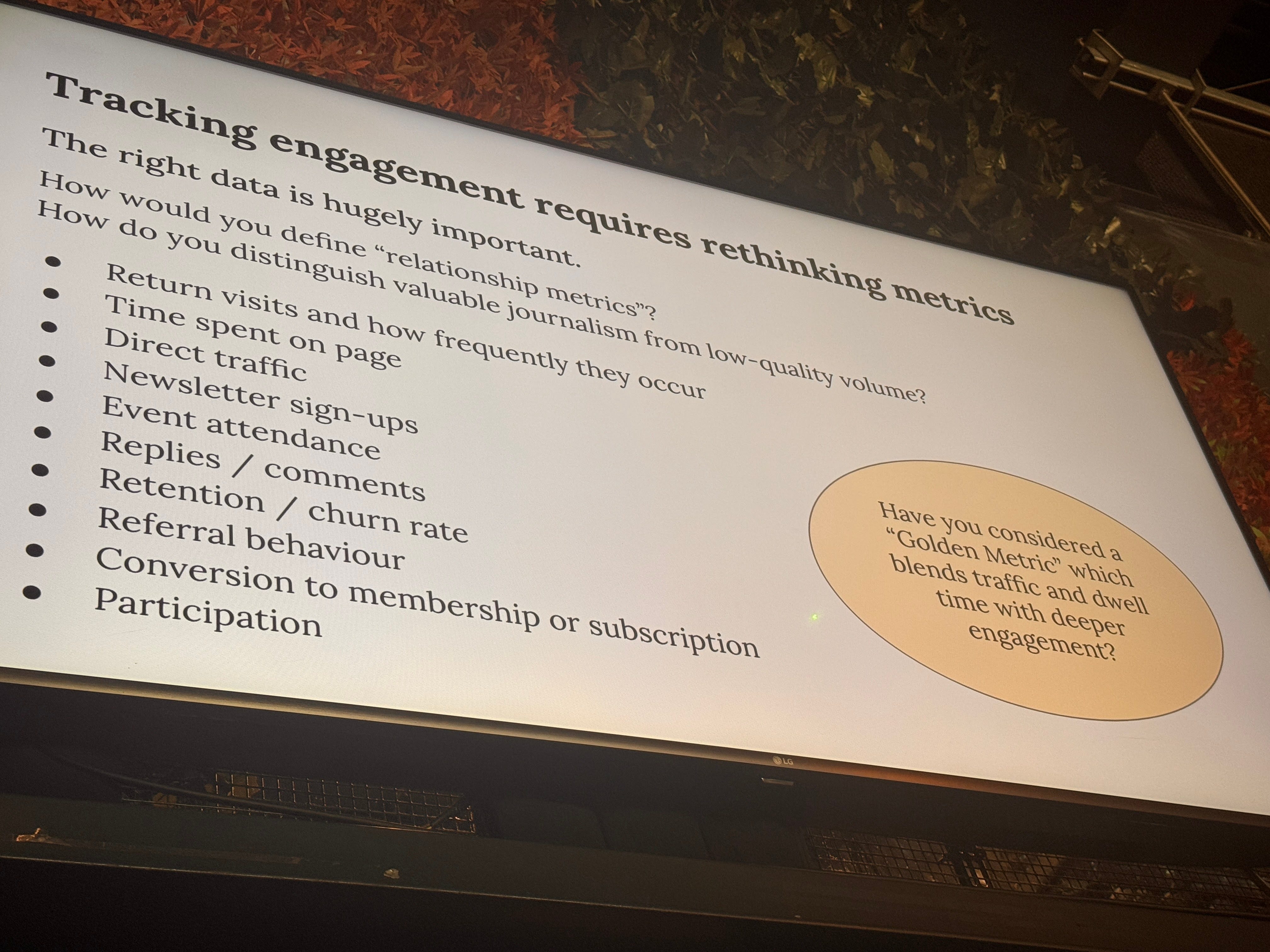
Sarah Ebner delivered a fantastic masterclass on driving audience loyalty ‘from reach to relationships.’ I really liked her idea of the ‘Golden Metric’ - something that really speaks to your overall business goal (other than revenue) that can be easily understood across departments. The point being, we all have many different metrics we are trying to hit so measuring actual success can get complex very quickly. So the Golden Metric reminds the business of what it is ultimately trying to achieve.
Other snippets:
I liked The Nerve’s approach to culture: “Culture is the Trojan horse to cover the most important news stories.” — Sarah Donaldson, Co-founder.
“You don’t need to be a big brand to be successful with newsletters. You just need to demonstrate utility and personality, and be designed for the inbox.” — Jake McGwire, Head of Product, beehiiv.
“What makes a newsletter different is that it has to come from the writer. This is your newsletter. The email is from the writer.” — Toby Moses, Head of Newsletters, The Guardian.
“People can read long texts, but you need short sentences where they can easily skip to something more relevant. Think about how you are organising the information. Condense what you are saying. Stop renting your audience from other platforms.” — Kate Day, Senior Executive Editor, Europe, POLITICO.
That’s it from me. I’m spending the rest of the week judging awards for Press Gazette. If there’s an event of story you’d like me to cover, or you’d like some help with your own content strategy, just get in contact via me@stevenwilsonbeales.com
Related articles