

Editor's note | Updated 21 November 2026. After publishing this article, I analysed the YouTube and TikTok data further and tested searches such as "rejoin the EU" and "EU referendum". The original piece suggested video production was outpacing public interest, based on search trends. The new findings changed that interpretation: cumulative views of the sampled video uploads rose faster than output, while a wider set of searches barely altered the trend. I've revised the conclusions and added evidence without changing the original figures.
Four findings from the research
Search and video viewing tell different stories. Searches for “Brexit” doubled, while October’s YouTube uploads had collected nearly eight times the views of a typical earlier month’s videos by 20 November.
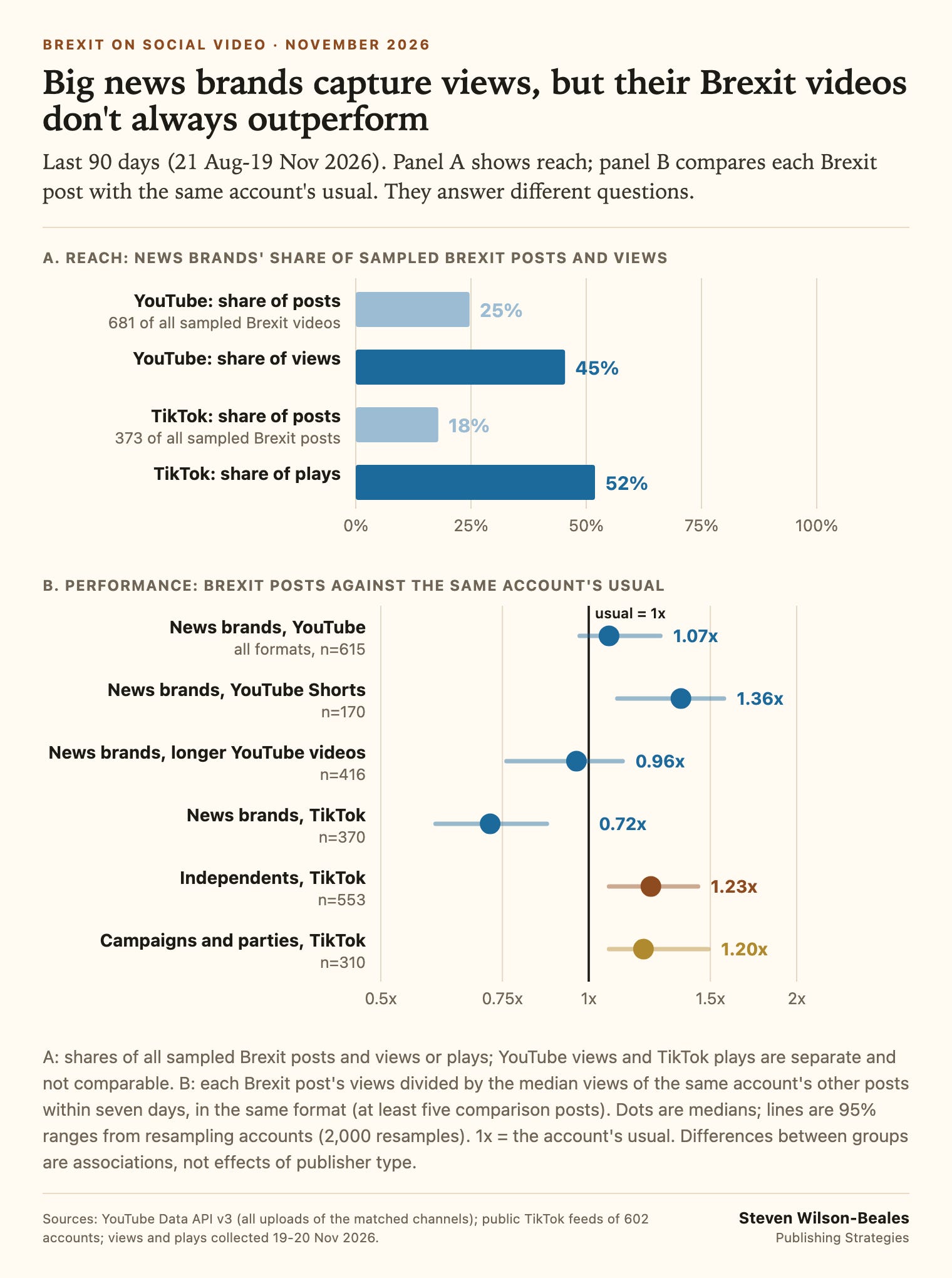
Big news brands have reach, not necessarily an edge on Brexit. They took roughly half the sampled views, but their Brexit TikToks did worse than their usual posts.
Shorts stood out on YouTube. News brands’ Brexit Shorts attracted 36% more views than their typical Shorts, while longer videos lagged slightly.
The language is changing, but “Brexit” still dominates search. “Rejoin” searches grew quickly from a small base, but including them barely changed the overall trend.
Here’s why the figures surprised me. UK Google searches for “Brexit” doubled between December-April and October. YouTube searches rose by about a third.
Across 87 channels, monthly Brexit uploads rose more than fivefold. Videos published in October had accumulated almost eight times the views of a typical earlier month’s uploads when I checked on 20 November. These are total views recorded at that date, not views watched during October.
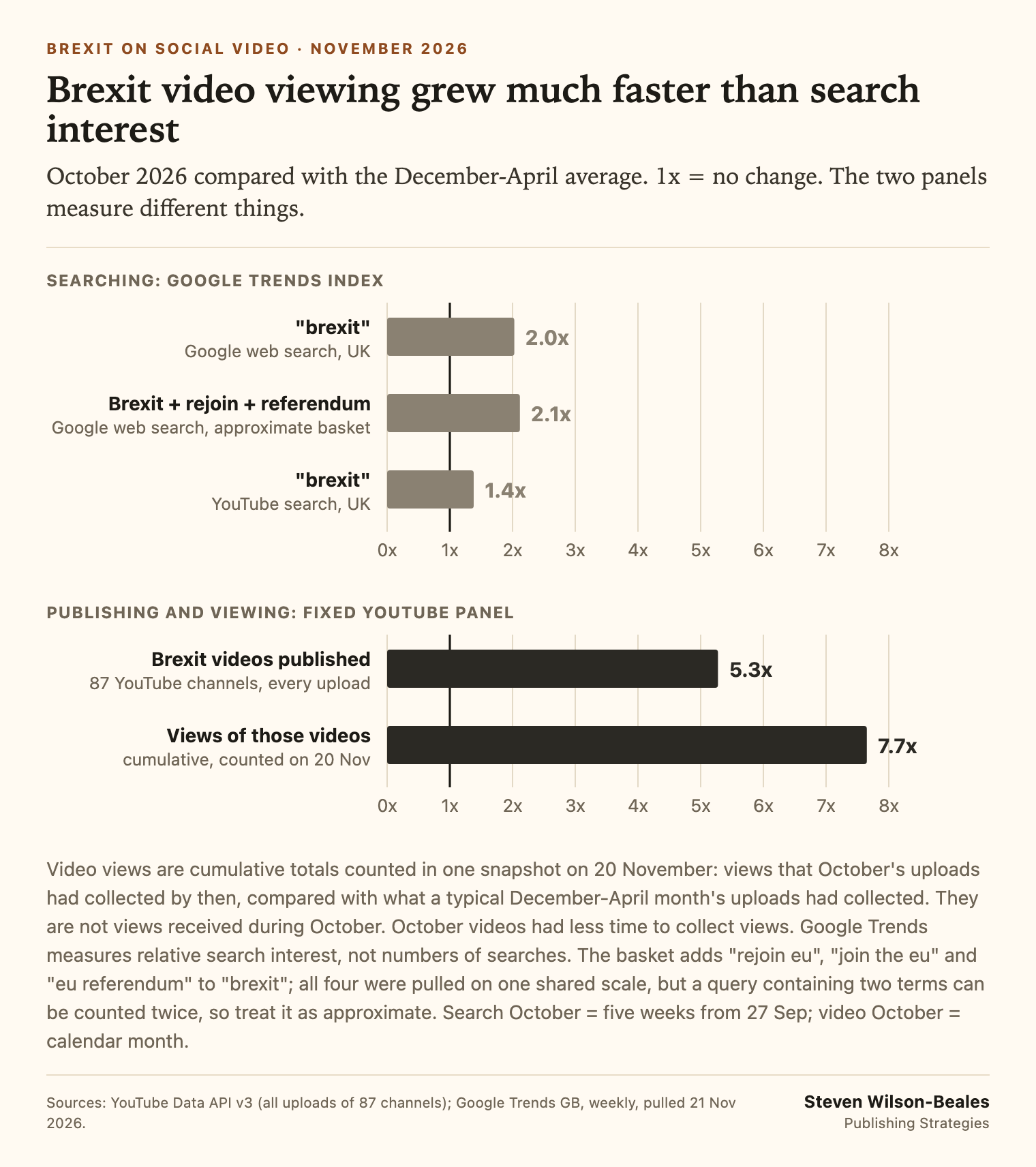
Search trends alone can’t tell editors how much attention a subject might attract on video. Equally, more views for one subject don’t necessarily mean more people are watching the channel.
Why Brexit, and why now
Brexit is back on the political agenda. Since becoming Prime Minister in July, Andy Burnham has reopened discussion of Britain’s relationship with Europe. In September, he said a future rejoin referendum was possible but not right for now. On 16 November he declared that “the Brexit we were given has not worked”. A UK-EU summit followed on 20 November, with agreements covering food checks, emissions trading and a youth scheme.
The government has not proposed rejoining the EU or holding another referendum, and its summit factsheet rules out the single market and customs union. Meanwhile, YouGov found that 58% think leaving the EU was wrong, even though only 14% name EU relations as a leading issue.
Is “Brexit” even the right word to measure?
There’s a reasonable objection to this research: is “Brexit” still what people search for when the debate is increasingly about rejoining the EU or holding another referendum?
I checked more than 20 related UK search terms. Searches for “rejoin eu” grew almost fourfold, but in October were still only about one-seventh as common as searches for “Brexit”.
Adding rejoin and referendum searches barely changed the overall trend: the combined group roughly doubled, as did “Brexit” alone. So the choice of keyword doesn’t explain why video viewing and search interest moved so differently.
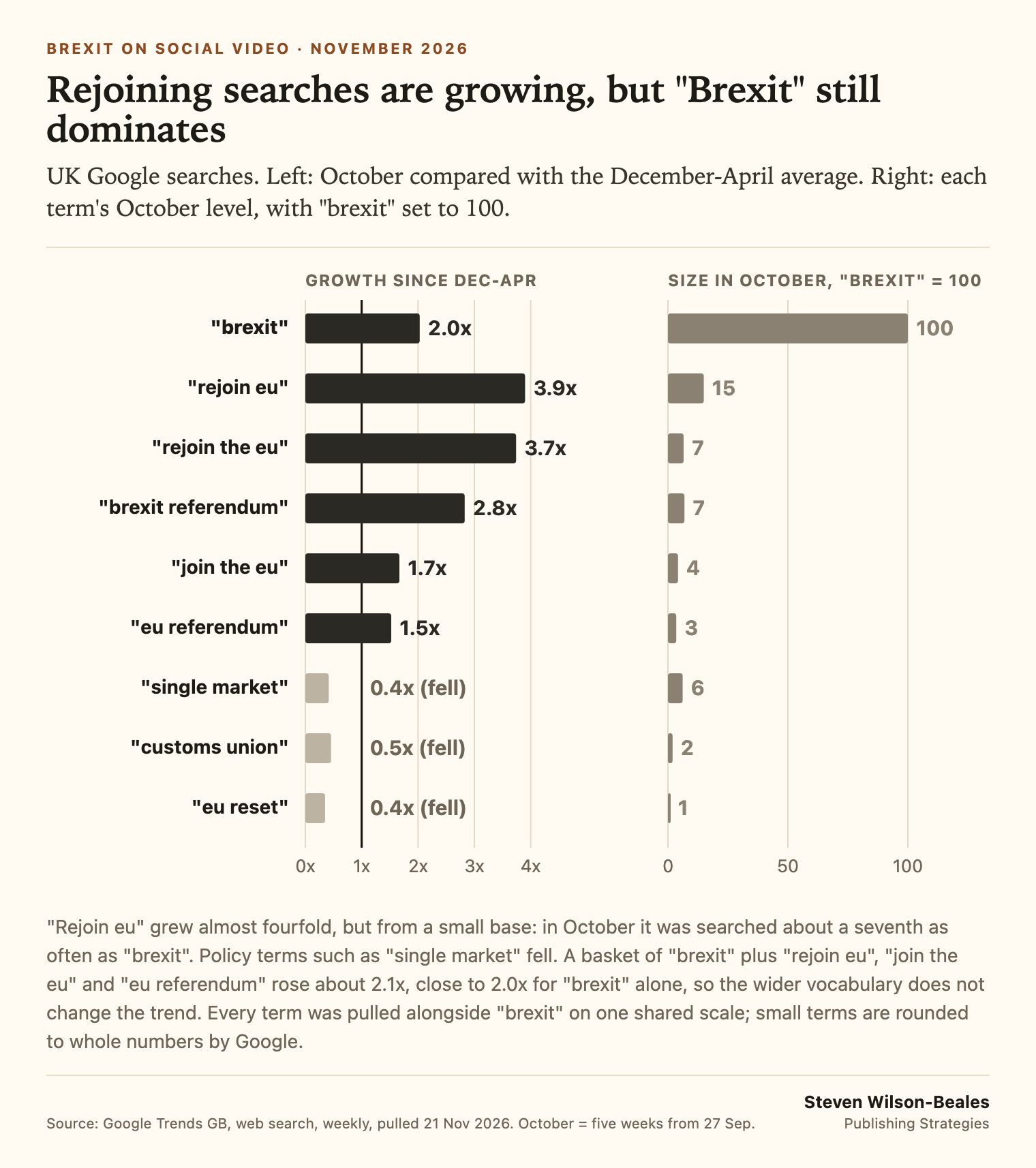
Video views rose, but that isn’t the same as audience growth
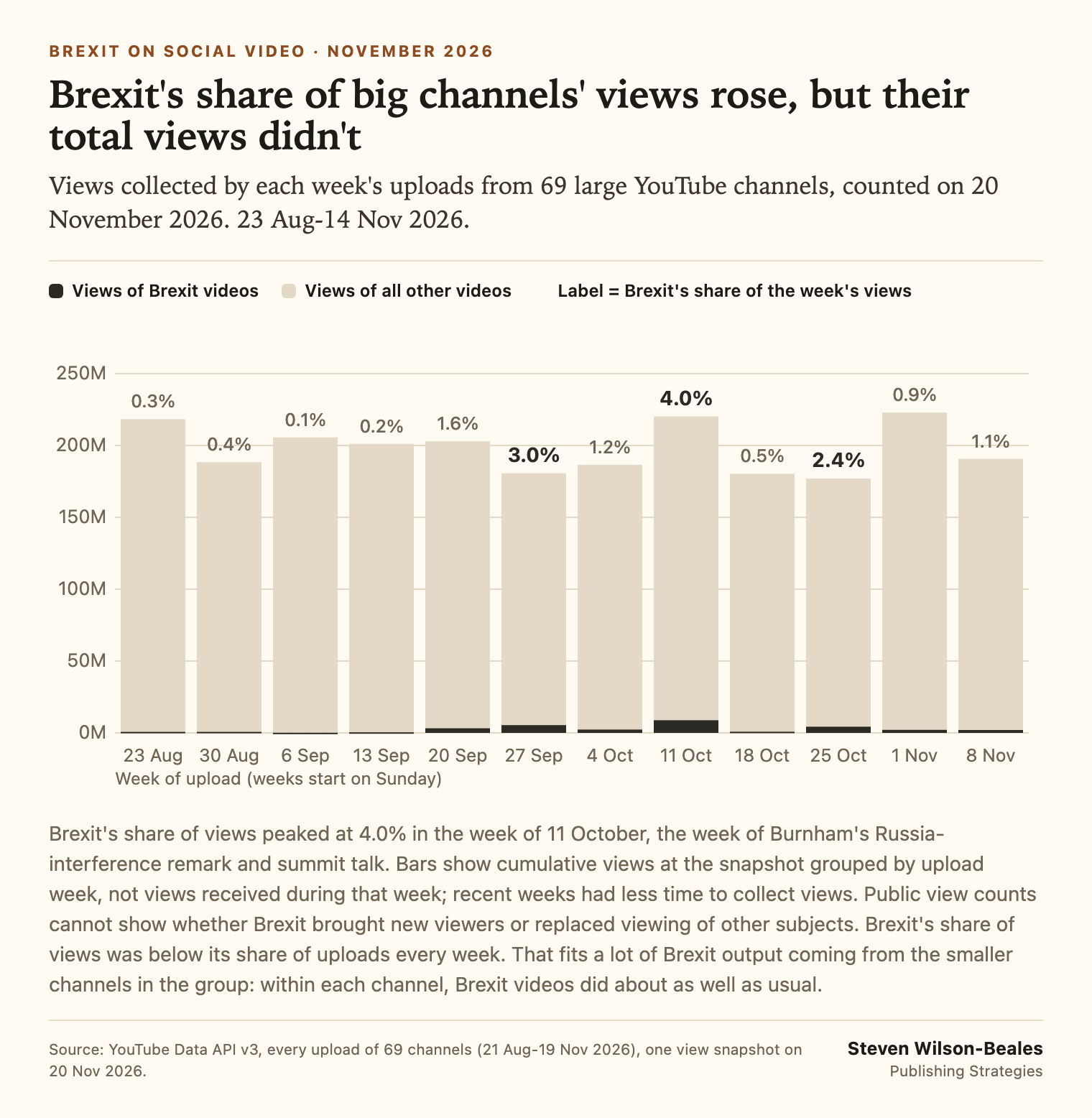
October’s Brexit uploads weren’t just more numerous. The typical video had 75% more views by 20 November than videos published in the quieter December-April period, despite being newer. It’s not a like-for-like first-week comparison, but it suggests the rise wasn’t only about posting more.
TikTok showed a similar pattern: tracked accounts posted around three-and-a-half times as often in October as in late August and September, while plays were around four times higher. The periods and platforms aren’t directly comparable.
The surge was concentrated: ten YouTube channels accounted for over half the extra uploads. Yet Brexit remained a small part of total viewing on 69 larger channels. Even during the busiest weeks, about 2.5% of their views went to Brexit videos, without a matching rise in overall channel viewing. That suggests a larger share of attention within those channels, not necessarily new audience growth.
News brands have reach. But did Brexit outperform?
Established media took 45% of sampled Brexit views on YouTube and 52% of TikTok plays despite publishing a much smaller share of posts. GB News recorded the largest total of any individual account in both samples.
The advantage partly reflects account size. When I adjusted YouTube results for subscriber numbers, the gap between news brands and other channels disappeared. Subscribers aren’t a perfect measure, so I also compared each Brexit video with similar posts from the same account that week.
On YouTube, news brands’ Brexit videos did about as well as usual. Shorts performed 36% better than their typical Shorts; longer Brexit videos did slightly worse.
On TikTok, news brands’ Brexit posts received 28% fewer plays than usual. BBC News’s Brexit clips attracted less than half their normal plays under the same comparison.
Independent creators and campaign groups beat their usual TikTok performance by 23% and 20% respectively. They didn’t necessarily attract more total views than large publishers, but Brexit was a stronger subject for their accounts.
Take one small TikTok account with 8,445 followers. A Brexit clip posted after Burnham’s banquet speech attracted 2.8 million plays by 20 November, almost as many as BBC News received across 19 Brexit TikToks in the three-month sample. That’s an exceptional hit, not the norm for small creators.
How Brexit is framed, and what the data can tell us
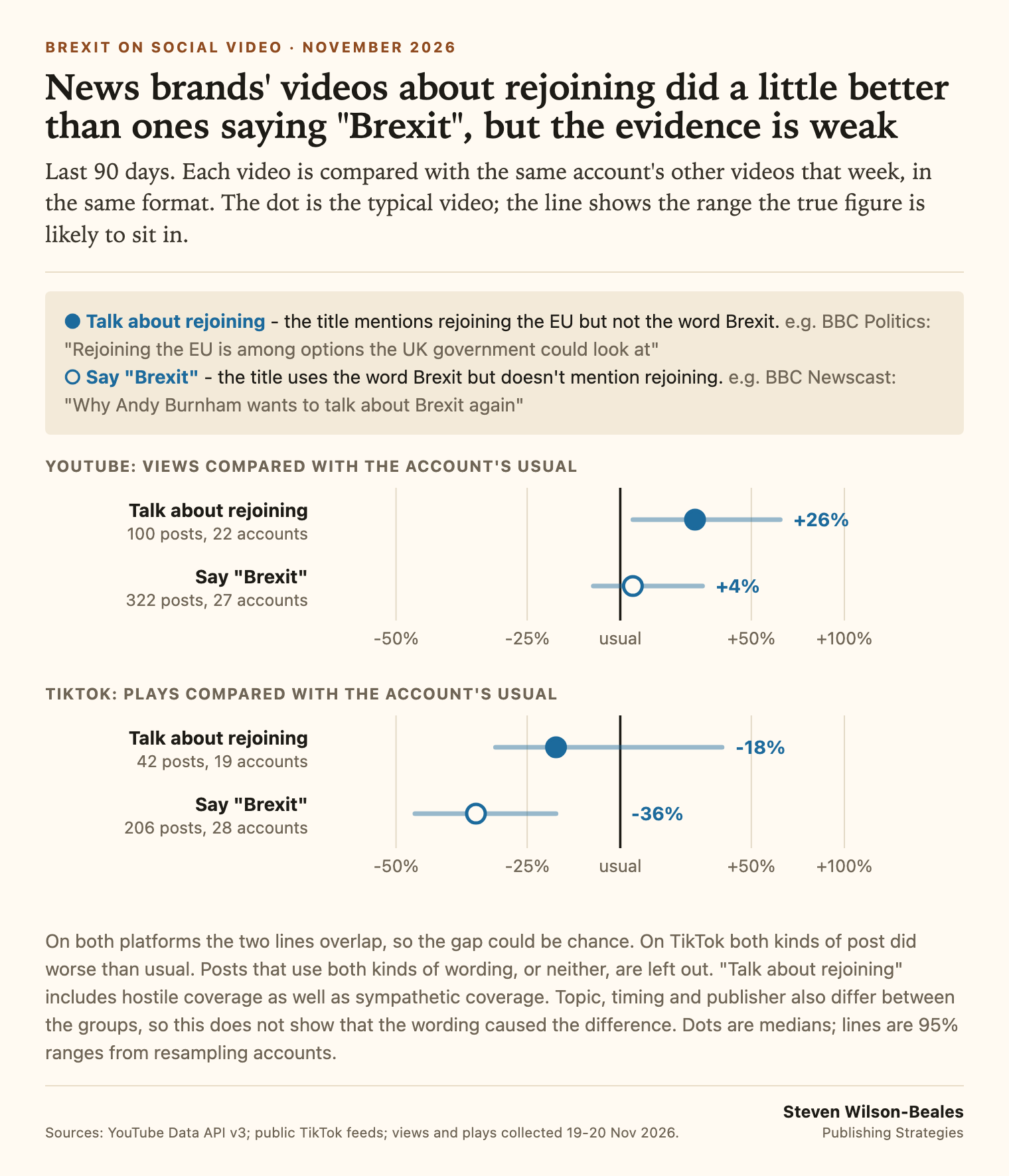
I expected newsrooms to stick with “Brexit” while creators used terms such as “rejoin”. The YouTube titles showed the opposite: fewer than half of news brands’ relevant videos used “Brexit”, compared with about two-thirds of independents’ videos.
The language is shifting. Earlier in the year, around one in three relevant YouTube titles avoided “Brexit”. By November, it was just over half. For journalists, that matters when researching, commissioning and measuring coverage.
There was a hint that forward-looking coverage might travel better. News-brand YouTube videos about rejoining without the word “Brexit” performed 26% above their usual level, compared with 4% above normal for videos using “Brexit” without mentioning rejoining. But the uncertainty ranges overlap, so wording alone may not explain the difference.
What newsroom leaders should take from this
Search tells you what people are asking, not everything they’ll watch. Use Trends alongside platform data when planning video output.
Don’t confuse a big audience with an unusually successful story. Compare videos with your channel’s typical performance, and measure returning viewers and subscribers where possible.
Give Shorts a proper test. News brands’ Brexit Shorts outperformed their usual Shorts in this sample; longer videos didn’t.
Investigate TikTok performance before posting more. Start with story choice, the opening seconds and audience retention.
Experiment with how you frame EU coverage. Rejoining-related videos showed promise, but this analysis doesn’t prove the wording caused better results.
How I did this
I used the YouTube Data API to examine 30 search terms and uploads from 115 channels. Trends over time use 87 channels tracked throughout the year; a separate comparison covers the full output of 69 larger channels. TikTok research covered public posts from 602 accounts over 90 days, collected on 19-20 November. Videos were selected from titles and captions. Manual checks found about 95% of the YouTube selections and 85-89% of TikToks relevant.
To test whether a Brexit video did unusually well, I compared it with typical views for similar-format posts from the same account, published within seven days. I resampled accounts to assess uncertainty. Google Trends shows relative search interest, not absolute searches. Video views were captured on 20 November and are cumulative, so upload groups had different amounts of time to attract views.
The samples don’t cover all of YouTube or TikTok. Titles and captions can miss relevant videos, and public view counts cannot identify unique viewers, discovery sources or whether the coverage brought in new audiences.