

I’ve been thinking about content strategy again. No, don’t click away. I’m talking about the sexy, James Bond-esque kind of content strategy that helps brands and publishers tackle the challenges of zero-click and AI search.
Is such a thing possible? I think so!
These days, it sometimes feels as though everyone is a content strategist. Commission a creator-led video series? Content strategy. Optimise an Instagram Reel? Content strategy. The term has become so widely used that it’s in danger of losing its meaning. A channel plan, however good, isn’t the same as a strategy.
That’s why I’ve revisited Kristina Halvorson’s Content Strategy Quad, first published by Brain Traffic in its current form in 2018. It’s a framework I’ve found enormously useful throughout my career, especially when bringing people from editorial, SEO, social, product and brand into the same room. A framework like this can give everyone a shared language, or at least a useful starting point for developing a model that suits your business.
But the way audiences discover information has changed. Zero-click search and AI answers mean people can learn about your brand without ever visiting your website. That doesn’t make the original quad wrong. But it does make me think we need to reconsider what sits at its centre and how machines interpret our content.
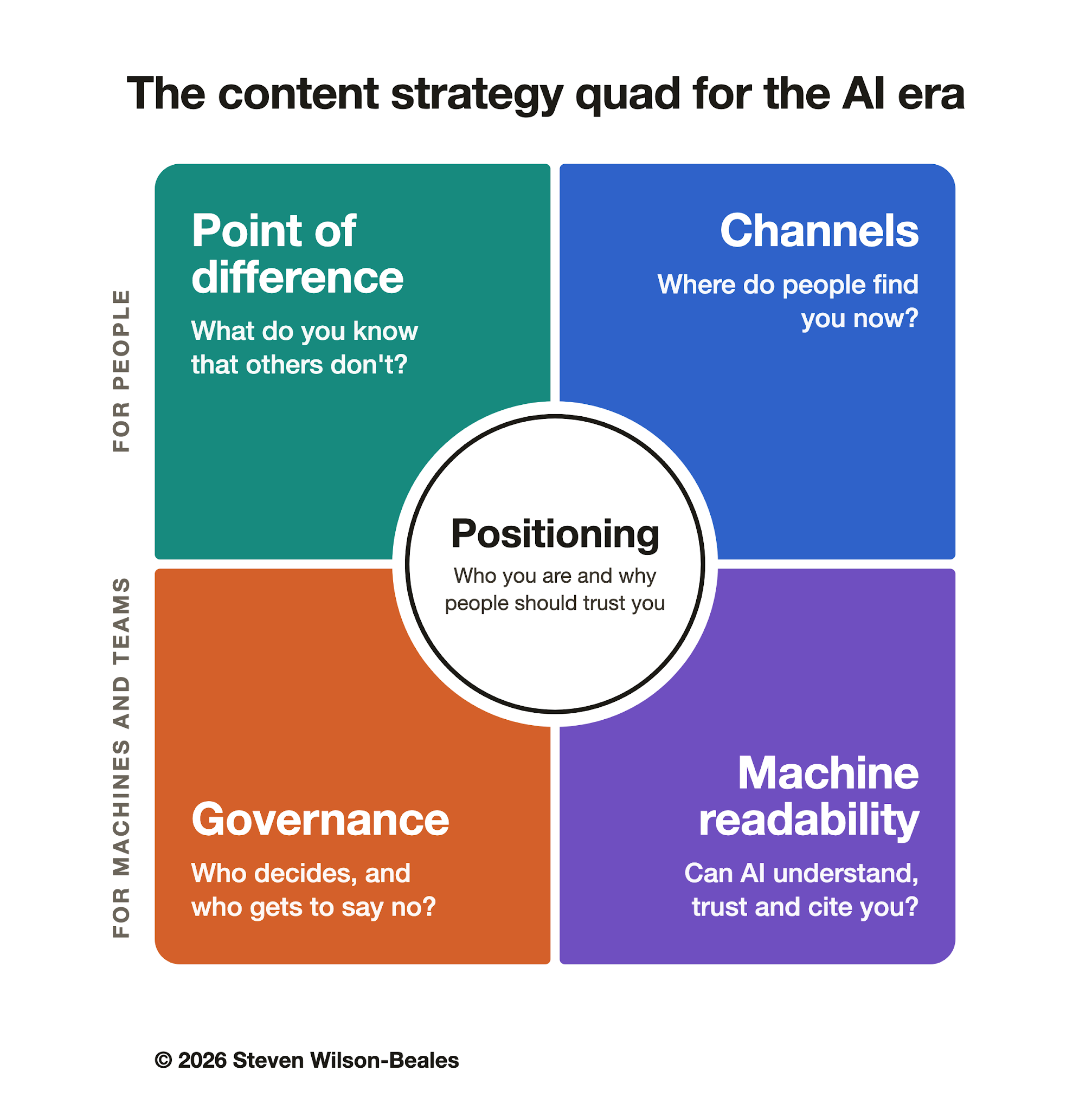
For me, positioning now sits at the centre. In a crowded market, even distinctive voices can be drowned out or reduced to a generic AI summary. You need to be clear about who you are, what makes you different and why anyone should trust you. The rest of your content strategy should reinforce that.
I’ve redrawn the quad around four connected areas: point of difference, channels, machine readability and governance. The first two concern what audiences encounter. The second two cover the systems, people and information that make your positioning coherent and discoverable.
If that sounds a little theoretical, the longer article also includes practical workshop exercises inspired by one of my favourite books, Gamestorming. I’ve used these activities to get teams talking, uncover disagreements and turn big strategic ideas into decisions.
You can read my full content strategy article here.
If your organisation is debating whether to invest in another platform, video format or AI tactic, I’d start with a simpler question: do you all agree what your content is for?