

As I write this, I’m acutely aware that many of you might not read it today because of Microsoft’s Outlook outage. I’m feeling the repercussions myself, with several of my LLM tools connected to my account. I’m sure plenty of people are scrambling to prepare reports they thought they could automate, only to find themselves doing the work manually.
And that idea of going back to basics was a recurring theme at Thursday’s GEO Elite conference in London.
Are we doing this GEO thing correctly? Should we be so reliant on prompt tracking to steer important business decisions? And, perhaps most importantly, are we actually talking to our customers?
There were some genuinely informative sessions, with presentations and a series of roundtable discussions that delegates moved between. The room had a healthy mix of agencies, consultants like myself and in-house SEO teams, some of whom had clearly been sent along to ask some very practical questions. Such as: how do you actually do prompt tracking?
That might sound slightly pejorative, but it’s one of the key challenges facing AI search optimisation. Many people are still figuring out how to do it properly.
It appears that plenty of businesses are effectively treating these new tools as rank trackers, uploading keywords directly or using AI to expand individual search terms into longer prompts. A publisher might, for example, track whether it appears for “best news websites” without considering whether people would actually trust, visit or subscribe to it.
All of this speaks to a wider madness affecting the industry: replacing one dashboard with another, looking for green ticks while traffic and subscriber numbers fall off a cliff.
As I always say to clients, let’s put a strategy in place before we start using these tools. Otherwise, they’ll give us a whole lot of data and very little we can actually work with.
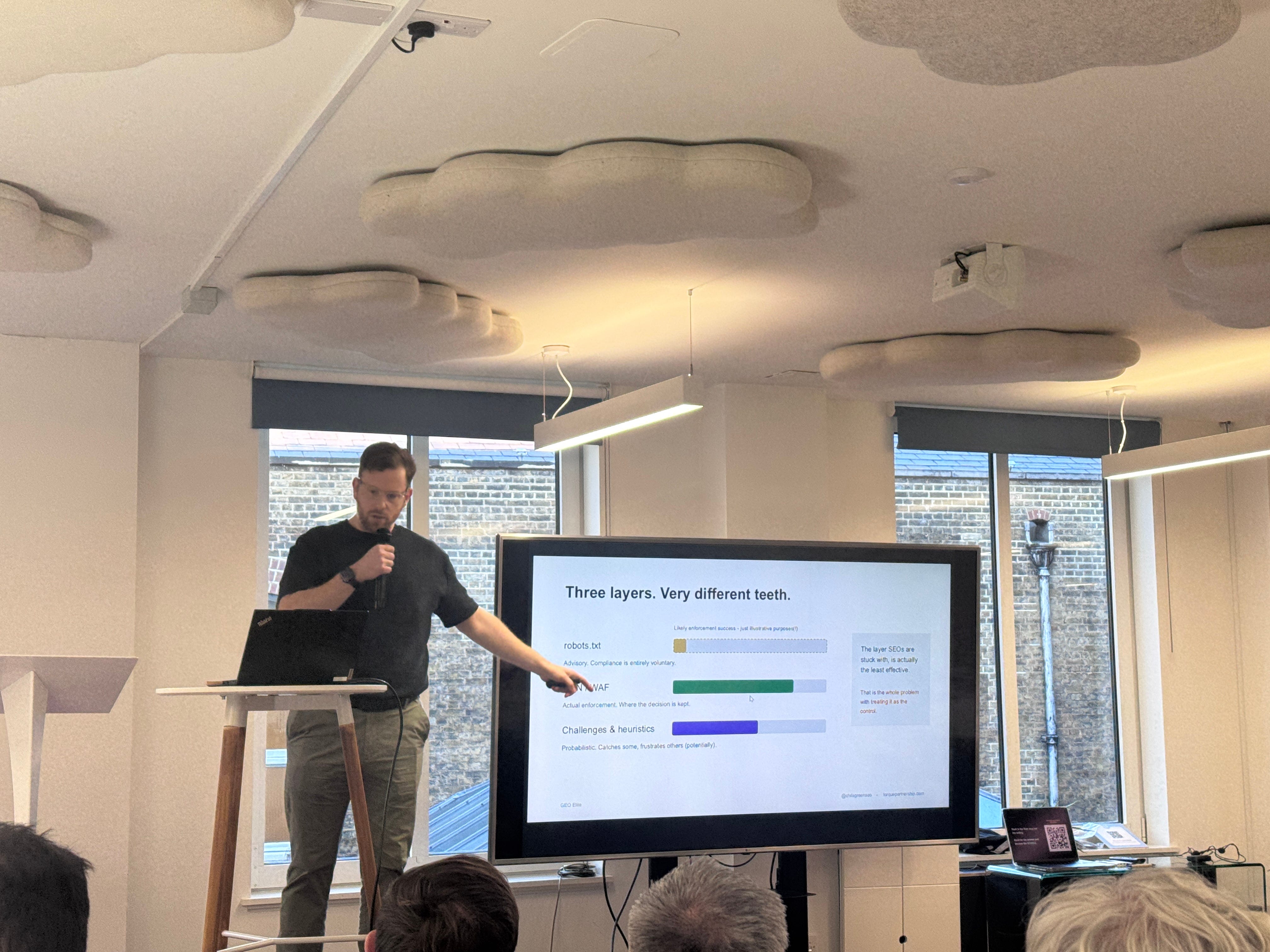
Also, as Chris Green pointed out, we should be careful about blocking AI bots before understanding what each one actually does. Block a training crawler and it could take yonks for any change of policy to have an effect. Equally, if your content is being scraped without permission, it’s worth understanding the different layers of protection available. A robots.txt file alone won’t stop a determined scraper.
Recognition isn’t the same as choice
“Recognition is not recall,” as Sophie Brannon pointed out, and it’s an important distinction.
You can have all the mentions in the world across AI search, but are you doing enough to improve your share of choice?
Your products might be accurately represented, with all the correct attributes, but when an LLM is asked to make a recommendation, does it actually choose you?
And are you answering the questions your audience is asking at the moments that matter, particularly those that might lead to a purchase?
These are fundamentally different questions from simply asking whether your brand appears in an AI-generated response. Recognition, recall and recommendation are related, but they aren’t interchangeable.
The next phase is already taking shape
Across the room, there was a sense that the full potential of LLMs and AI search has barely been realised.
The path towards agentic commerce and wider adoption has been slowed by technical barriers and commercial gateways already being put in place.
But the moment someone realises they don’t need to visit a website to order toilet rolls or toothpaste, and can simply ask an AI assistant to sort it out, I suspect they’ll be hooked. Of course, that depends on getting trust, payments and authorisation right.
“Your new homepage is your shopping feed,” Gerry White observed, which struck me as a particularly good line.
You can clean and restructure your product data as much as you like, but your brand positioning in the market will still be critical. People want to know who they’re buying from.
Well, perhaps not when it comes to toilet rolls.
And that brought me back to William Gibson’s famous observation that the future is already here, just not evenly distributed. The same feels true of AI search.
Businesses should certainly be investing time in understanding what LLMs can do and how consumer behaviour might change. But judging by many of the conversations I had at the conference, some of the most important challenges remain remarkably simple.
Is your company telling the right story about itself? Do you understand what your customers actually need? And when an AI assistant is asked to recommend a product or service, are you giving it a compelling reason to choose yours?
For publishers, this raises an especially awkward question: is appearing in an AI answer enough if the reader never chooses your journalism, visits your site or becomes a subscriber? Visibility is only useful when it contributes to something you actually value.
I’m sure many of the brands that attended will be thinking and writing about these questions.
As soon as they can get Outlook working again, that is.