

A year ago, Paul Hood, Head of Publishing at the House of Commons, made some predictions about AI and publishing. Kicking off the Flashes & Flames AI Forum in London, organiser Colin Morrison sat down with him to tick each of them off.
“I think I was roughly right, but understated,” said Hood. He’d forecast a 20% to 30% fall in search traffic but now pointed to Chartbeat’s data showing Google search referrals had actually fallen by just over 40% between July 2025 and July 2026, and by up to 60% for small publishers. Elsewhere, licensing deals with AI companies haven’t turned into serious money. The UK and US bot bills are still unfinished. And bots now account for most of the traffic on the open web.
That set the tone for much of the day: what replaces search traffic, whether to woo or block the bots, and how publishers can diversify revenue without losing sight of the audience.
Those figures deserve scrutiny. There is no doubt that Google is sending less traffic to publishers, but the scale of decline depends on what you measure, which publishers you include and the period you compare. Zero-click does not mean no clicks. There is still an audience worth competing for, even if winning it has become considerably harder.
But let’s crack on. Here are the five lessons…

1. You can optimise for visibility, but you have to earn trust
Although AI search wasn’t really the focus of the conference, Matthew Yorke of The Channel Company made a good point. To surface in LLMs, he said, “you need to be a citation”, and citations depend on brand, history and recognition as a trusted source. He reckoned he could give a couple of “really smart kids” a small budget and achieve visibility in LLMs. But would that persuade people to click? “You cannot optimize for trust,” he said. His point was that brand reputation is built over time, not manufactured by a clever optimisation tactic.
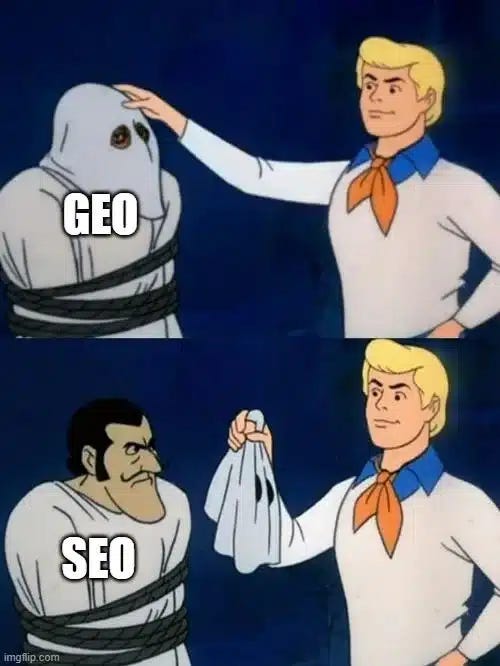
My own research recently found that when AI assistants assess a news publisher’s trustworthiness, much of the evidence comes from third-party websites. AI often learns about a publisher’s reputation second-hand. There is also a distinction between being cited and benefiting commercially: a mention might reinforce authority, but it does not necessarily result in a visit, registration or subscription. GEO can improve discoverability in the short term. It cannot manufacture the trust that makes someone choose your publication.
Something I’d remind those pesky smart kids whilst also pointing to this marvellous meme:
2. Your next customer might not be human
In the late-afternoon session on big tech, Markus Franz of Ippen Digital asked what happens if the next reader of your content is an agent rather than a human. Lucky Gunasekara, CEO of Miso AI, suggested publishers could sell content access directly to law firms, hedge funds and coding companies for five- or six-figure sums. MCP (Model Context Protocol) is one way to connect AI applications to data and tools. But MCP itself is not a licensing or payment system: publishers still need authentication, access controls and commercial agreements.
Then came a show of hands. Few people in the room were selling access to agents yet.
Earlier, Tom Jackson, CTO of News UK, raised the other side: agents acting for subscribers, including cancelling their subscriptions. If an agent handles the cancellation, your win-back email has nobody to persuade. It’s the intention economy arriving in subscription marketing.
3. Publishers are starting to treat access as a commercial asset
The policy panel offered some of the day’s most practical advice. Paul Shanley said the Associated Press moved away from treating every crawler as a potential sales lead, instead allowing approved bots and blocking others. He said that approach increased inbound licensing enquiries. Tami Hoffman of The Guardian made the commercial case: if content remains freely available to scrape, why would a company agree to pay for it? But controlling access is not the same as blocking every AI system indiscriminately.
Nor is effective blocking simply a line in robots.txt. Miso described tests in Denmark and Sweden in which its systems reportedly retrieved publishers’ latest articles, including some behind paywalls, in 98% of attempts. That deserves scrutiny: retrieving content does not necessarily establish that a security boundary was breached. Residential proxies, meanwhile, can make automated requests look like ordinary readers.
There are trade-offs. Google now offers a Search Console control allowing publishers to exclude their sites from generative AI search experiences, including AI Overviews and AI Mode, without withdrawing from conventional Search. But opting out still means forgoing visibility and potential referrals from those AI features. Chris Green made the broader point at GEO Elite last week: understand what each bot does before deciding what to block.
Policy may help, although publishers should check the current status of proposed UK and US bot-transparency legislation rather than assume legislation will solve the problem soon. Meanwhile, the approach described in the room was a mixture of licensing negotiations and enforcement: do deals where they make commercial sense, and challenge unauthorised use where necessary.
4. The best AI projects solve business problems, not technology problems
For all the anxiety about traffic, the company case studies were among the most upbeat sessions of the day. Three numbers caught my attention:
Newsquest’s in-house AI copywriting tool lifted local story output from about 45,000 stories a month to about 65,000 over three years, while journalist numbers rose by around 5%. Henry Faure Walker said the time saved goes into community reporting, which builds loyalty.
Christian Broughton said The Independent’s Bulletin summaries reach up to 12 million users a month. He also said news editors using the Independent’s AI production tools earn six times as much money for the business as similar staff who don’t.
Immediate has 1.2 million subscribers and wants 3 million by 2030. A Good Food editor with 40 years’ experience used AI to turn archived recipes into bookazines in under half the usual time.
These are large groups with resources to experiment, which many smaller publishers lack. And the numbers need context. Does six times the revenue reflect a like-for-like comparison, or differences in desks, seniority and output? More stories are not automatically more value. Adriana Whiteley of FT Strategies said many AI projects deliver poor returns, while Amin Mrini of Informa argued that ROI remains unmeasured when organisations deploy tools without changing the work itself.
The more convincing examples began with a business problem rather than a tool. They also reinvested time saved in work they believed readers would value. That is a better measure of success than output volume alone.
5. The real competitive advantage is what AI cannot replicate
The harshest verdict concerned content itself. Adriana Whiteley said an FT Strategies index found that about 80% of the content it tested was, on average, replicable by AI because it added little beyond a public source. Some publishers scored as low as 2%. Those are striking findings, although the definition of ‘replicable’ matters. The wider point was clear: publishers need original reporting, expertise and insight that cannot simply be reconstructed from material already available elsewhere.
Hood captured the underlying economics: “traffic is rented, and relationships are the freehold.” Rather than judging everything by raw reach, publishers should look at the loyal readers who generate disproportionate value. Comments, newsletters, events and communities give people reasons to return, and give publishers more than an anonymous page view. It echoed a theme I heard at the Media Voices summit in July: stop renting your audience.
Based on what I heard, here is what I’d prioritise:
Keep earning the search clicks that remain. Use Search Console to identify queries and pages that still bring people in, then follow those visits through to registrations, repeat visits and subscriptions.
Measure the relationships you own. Track direct and returning readers, newsletter engagement, registered-user activity, subscription conversion and retention, not just traffic totals.
Understand machine access. Review server logs, CDN reporting and paywall access; distinguish known crawlers from automation disguised as human visits. Set out permitted machine uses in your terms and commercial agreements.
Check what AI says about you. Test real reader questions across major assistants, examine whether your brand is recommended or merely mentioned, and assess the third-party sources shaping those answers.
Audit commodity output. If a story largely rewrites material anyone can find, ask whether that work would be better invested in original reporting, expert analysis or audience services.
Work collectively where it helps. Trade bodies and licensing initiatives can give smaller publishers negotiating power they may not have alone.
Search traffic may never return to its previous levels. That is not an argument for abandoning search. The challenge is to make those increasingly hard-won visits count: turn passing readers into regulars, give them reasons to register, subscribe and return, and build products and communities whose value comes from the relationships behind them.
As Hood put it, traffic is rented, but relationships are the freehold. Publishers still need visitors. They just need to spend more time building something they actually own.
Until next time,
Steve
I suspect a lot of publishers are hoping AI will save the business model without having to change the business model. It's certainly more comfortable to buy another tool than to question how you've been making money for the past 20 years.